| By Terry Perkins 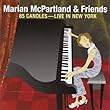
This series began with a look at the National Public Radio show, Jazz Profiles, and its host Nancy Wilson. NPR is also the home of another very popular jazz program, Piano Jazz, hosted by famed pianist Marian McPartland. The premise of Piano Jazz is deceptively simple. McPartland welcomes a guest for each hour-long episode, they talk about music, and McPartland and the guest play music in interludes between the on-going conversations.
The results over the past 27 years speak for themselves. Piano Jazz is now the longest-running cultural program to ever air on NPR, and it reaches listeners in 45 states and more than 20 foreign countries every week. Over the years, almost every important jazz artist of the time has appeared on the show as well as many young, rising stars on the music scene.
But what may seem like a simple premise for a radio show is not always so easy to execute. What makes piano jazz special is McPartland herself. Her combination of English civility and courtesy (she was born in a small village near Windsor castle outside London), her genuine love of jazz, and her curiosity about the musicians she interviews help create a relaxed setting that puts her guests at ease. As a result, nearly 40 Piano Jazz shows have become memorable classics and released as CDs on the Jazz Alliance label.
As you might expect, many jazz standards are discussed and performed on episodes of Piano Jazz. But the real focus of the series is on the creative process of jazz itself rather than on specific material. However, in a recent conversation from her home in New York, McPartland emphasizes that the show serves as real education for her in terms of wide-ranging interpretations of jazz standards.
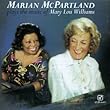 Marian McPartland Plays the Music of Mary Lou Williams
“Since it’s a jazz show,” explains McPartland, “you hear a lot of the same tunes. But they are played so differently that those standards really serve as mirrors to reflect the creative approach of the musicians who are guests on the show.”
Examples abound, ranging from the first Piano Jazz show featuring the legendary Mary Lou Williams playing “Caravan” to a recent episode with Elvis Costello that showcases him singing “My Funny Valentine” and “You Don’t Know What Love Is.” For McPartland, those great tunes that have established themselves as jazz standards serve as a real touchstone for succeeding generations of jazz musicians.
 “I think all of the tunes we know so well by Cole Porter, Harold Arlen, Hoagy Carmichael, and everyone-those to me are all the great tunes,” she states. “Rodgers and Hart, Rodgers and Hammerstein and the other great writers-those are the songwriters who produced memorable tunes that will always be with us. For example, yesterday I was playing a concert in Rochester at the Eastman School, and I heard a young pianist, a student there, who is just terrific. I thought I’d have him on the show. And when he came on, he knew every standard I could name. So there’s no question that those songs continue to be played and continue to make a strong impression on young musicians.”
McPartland herself has left many lasting impressions on the world of jazz since she first began playing music professionally in England. In 1938 at the age of 20 she performed in a four-piano vaudeville review called the Claviers. Her first love remained jazz, and after marrying cornet player Jimmy McPartland during World War II she moved to the States. McPartland established a long-standing engagement at the Hickory House in Manhattan from 1952 to 1960 in a trio setting that showcased her talent and cemented her reputation in the jazz world.
Since then McPartland has recorded more than 60 albums as a leader in addition to her appearances on the Piano Jazz series of recordings. Her most recent recording, Marian McPartland & Friends: 85 Candles-Live in New York, is a 2-CD live set recorded at Birdland and featuring an amazing array of guest artists from vocalists Karrin Allyson, Nnenna Freelon, Norah Jones and Curtis Stigers to legendary players such as Billy Taylor, Clark Terry and Phil Woods to young stars like Roy Hargrove, Chris Potter and Regina Carter.
It’s clear that her involvement with Piano Jazz has become a touchstone in McPartland’s musical career. It brings together her talents as a pianist, her curiosity about the many styles of jazz, and her interest in jazz education. But when Piano Jazz first started, replacing Alec Wilder’s radio show based on his book, American Popular Song: The Great Innovators, 1900-1950, McPartland had no expectations of the program lasting more than a year at the most.
“When Alec’s show ended, they were looking for somebody else, and Alec recommended me, although I never knew it at the time,” she recalls. “So I ended up getting a call from someone at the radio network about doing it, and, of course, I was very excited. At the same time, I thought, ‘This isn’t going to be something that lasts too long, but it should be great for a few months.’ That’s how it started. And after awhile, everyone could tell it was something that was pretty good.”
At first, McPartland focused solely on fellow pianists as guests, but as the show evolved, she began to gradually expand the criteria for guests.
“In the beginning, I just had piano players on,” she states. “I hurried up to get people like Bill Evans and Hazel Scott, John Lewis and George Shearing. I was like a kid in a candy store, trying to talk to everyone I knew and all the best names around. Then, as time went on it seemed to be a good idea to me if we could have people who play other instruments as well as the piano. For instance, we had Garry Burton and Dizzy Gillespie. I loved Dizzy and he taught me a lot about piano that day too!
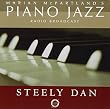 “As time went on, we got to the point that we had people on who didn’t have to play piano-J.J. Johnson, Tony Bennett. Then I thought we could actually have people who didn’t play at all. I invited the writer Nat Hentoff, because he was such a knowledgeable person about jazz. We’ve also had contemporary musicians like Donald Fagen and Walter Becker of Steely Dan, Bruce Hornsby, and Elvis Costello. The audience seems to like it when we mix things up.” “As time went on, we got to the point that we had people on who didn’t have to play piano-J.J. Johnson, Tony Bennett. Then I thought we could actually have people who didn’t play at all. I invited the writer Nat Hentoff, because he was such a knowledgeable person about jazz. We’ve also had contemporary musicians like Donald Fagen and Walter Becker of Steely Dan, Bruce Hornsby, and Elvis Costello. The audience seems to like it when we mix things up.”
Thinking back over the many Piano Jazz shows she has done over the years, McPartland made it a point to emphasize in her typically English fashion that “... in a way, they all bring back fond memories.”
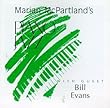 But she finally did admit that one of her early shows with the great pianist Bill Evans (still available in the Piano Jazz CD series) just might be her favorite. But she finally did admit that one of her early shows with the great pianist Bill Evans (still available in the Piano Jazz CD series) just might be her favorite.
“Having Bill on was probably one of the best shows I’ve had in all the years I’ve been on the air,” she recalls. “He really opened up and talked about how he went about creating his music. It was done just a couple of years before he passed away, and it was just a wonderful moment.”
In addition to her work on Piano Jazz, McPartland still maintains regular concert appearances throughout the year as well, although she does limit them to just a few per month. She’s also getting ready to record a new CD. And naturally enough, the idea came about through a conversation on Piano Jazz.
“I will be doing another record this year,” states McPartland. “I’m going to be doing some Burt Bacharach tunes. He was on the show and told me he was disappointed that very few jazz people recorded his songs. He has so many great songs, so that’s what I’m going to do. But I’m not going to tell him beforehand, though!” |



