|
|
|
| “Belle Baker had just lost her husband, and, struck by the personal sense of loss conveyed in the lyrics, broke down weeping during a performance. The press picked up the story and before long the song was a hit.” |
|
 |
|
- JW
|
|
| |
Vaudeville star Belle Baker introduced the public to “All of Me” over the radio in 1931. Detroit songwriters, Seymour Simons and Gerald Marks, offered Baker the song, and she sang it onstage at the Motor City’s famous Fisher Theatre. As the story goes, the singer had just lost her husband, and, struck by the personal sense of loss conveyed in the lyrics, broke down weeping during a performance. The national press picked up the story and before long the song was a hit.
|
| |
| |
|
| |
|
A December 1, 1931, recording of “All of Me” by Paul Whiteman and His Orchestra, with vocalist Mildred Bailey, was the song’s first major hit. It entered the pop charts in January of 1932 and rose to the number one position where it held for three weeks. By February three renditions of “All of Me” were on the charts, Louis Armstrong’s version also climbing to number one. All told, the hits included:
- Louis Armstrong (1932, #1)
- Paul Whiteman and His orchestra (1932, Mildred Bailey, vocal, #1)
- Ben Selvin and His Orchestra (1932, #19)
- Count Basie and His Orchestra (1943, Lynne Sherman, vocal, #14)
- Frank Sinatra (1948, #21)
- Johnny Ray (1952, #12)
|
|
| |
|
| |
|
“All of Me” was also included in the 1932 Fox Studios comedy, Careless Lady, starring Joan Bennett and John Boles. A New York Times review characterized the film as “artificial,” “strained,” and “haphazardly directed so lacking in suspense that a child could hazard a guess as to how the tame complications are going to be untangled.”
After 1932, “All of Me” was largely forgotten until after World War II when a 1948 Frank Sinatra recording was a modest hit. It resurfaced again when Sinatra sang it in Meet Danny Wilson (1952), giving a boost to Johnny Ray’s recording that same year.
At the 2000 Award and Induction Ceremony, the Songwriters Hall of Fame selected “All of Me” as one of two songs to receive that year’s Towering Song Award. Praising the Marks/Simons composition, the SHOF comments,
Truly a Towering Song, “All Of Me,” first introduced by the singing star Belle Baker, was recorded by Frank Sinatra four different times, each time with a different interpretation. More recently, country star Willie Nelson, also recorded “All Of Me,” a version which enjoyed a lengthy stay on both the pop and country charts.
|
| |
| |
|
| |
|
|
| |
| |
|
| |
|
|
|
|
|
More information on this tune... |
|
|
 Henry Martin
Enjoying Jazz
Schirmer Books
Paperback: 302 pages
(Author Martin devotes two pages to “All of Me” including a musical analysis, a list of performers, and a jazz solo transcription.)
|
|
|
|
See the Reading and Research page for this tune for additional references. |
|
- Jeremy Wilson
|
|
| This section suggests definitive or otherwise significant recordings that will help jazz students get acquainted with
“All of Me.” These recordings have been selected from the Jazz History and
CD Recommendations sections.
|
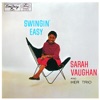
Louis Armstrong’s 1932 recording of “All of Me” ( This Is Jazz, Vol. 23: Louis Armstrong Sings) is a stand-out performance both musically and for the impact it had on making the tune a standard in jazz circles. Over twenty years later, Lester Young provided one of his late-career classics in a quartet performance of “All of Me” ( Pres and Teddy) along with pianist Teddy Wilson. Meanwhile, Sarah Vaughan’s 1957 version ( Swingin' Easy) is one of the great modern versions of the tune and a wonderful example of her scatting.
Noah Baerman - Jazz Pianist and Educator
|
The lyrics for “All of Me” elaborate on the sentiment,
You took … my heart, so why
not take all of me?
The 20-bar introductory verse is almost never
sung; its lyrics add little and almost seem to ramble
in relation to the succinct 64-word refrain.
Using an A-B-A-C form, Simons and Marks introduce
their title and melodic hook two times in the first
three bars of the song, beginning and ending those
measures with “All of Me.” Although the melodic
hook and its variations repeat throughout the song,
Marks and Simons wisely prevent the lyrics from
becoming boring, saving the lyrical hook, “All of
Me,” until the very end.
The chord changes for “All of Me” are frequently
used by jazz musicians for their improvisations
and for new compositions, two examples being “Background
Music” by Warne Marsh and “Lo Flame” by Bill Dobbins.
- JW
|
Musical analysis of
“All of Me”
|
| Original
Key |
Bb major;
brief foray into G minor during the bridge |
| Form |
A – B – A
– C |
| Tonality |
Primarily
major |
| Movement |
Lots of arpeggiation,
generally downward with some chromatic embellishments |
|
Comments
(assumed
background)
|
|
This is one of the most (over)played pieces in the
Dixieland/Traditional jazz repetoire. The
chord progression is based on circles of
fifths, starting with I – III7 (“Charleston,”
“You’re Nobody ‘til Somebody Loves You”),
using minor substitutions. The “A” does
not resolve to V7 – I, however, going directly
from ii back to III7, then starting the
circle again and finally resolving to V7
– I as it goes into the second “A”. The
only real harmonic surprise comes in the
fifth measure of “C”. Where we might expect
to hear a II7on its way to V7, the composer
instead uses a iv, sometimes played as a
ii7(b5). Since the melody here lands on
the flatted sixth degree of the scale (Gb
in the original) and the chord of the moment
is preceeded by a VI7 (its own V7chord),
there are virtually no other chords that
would work in this spot. |
|
K. J. McElrath - Musicologist for JazzStandards.com |
|
Benny Carter, alto saxophonist,
trumpeter and arranger, was among a group of talented
musicians for whom leading a big band became a financial
disaster (Bunny Berigan, Jack Teagarden and Bobby
Hackett, just to name a few, suffered as well).
Fortunately Carter’s big band made a number of great
records, leaving a legacy illustrating his great
playing and that of his sidemen.
His 1942 recording of “All of Me” is a treat.
He began arranging in the 1920’s with Fletcher Henderson,
and his writing for saxophone section, which leads
off this performance, was unparalleled. (He later
arranged, wrote and conducted for films and television).
A rare treat on the last chorus of Carter’s arrangement
is a marvelous solo on clarinet, an instrument he
seldom played but of which he was a master.
Chris Tyle - Jazz Musician and Historian
|
Additional information for "All of Me" may be found in:
|
|
|
 Thomas S. Hischak
The Tin Pan Alley Song Encyclopedia
Greenwood Press
Hardcover: 552 pages
(1 paragraph including the following types of information: film productions, lyric analysis, history and performers.)
|
|
|
|
|
 Robert Gottlieb, Robert Kimball
Reading Lyrics
Pantheon
Hardcover: 736 pages
(Includes the following types of information: song lyrics.)
|
|
|
|
|
Henry Martin
Enjoying Jazz
Schirmer Books
Paperback: 302 pages
(2 pages including the following types of information: music analysis, performers and jazz solo transcription.)
|
|
|
|
|
“All of Me” was included in these films:
- Careless Lady (1932)
- Meet Danny Wilson (1952, Frank
Sinatra)
- Down Among the Sheltering Palms
(1953, Gloria DeHaven)
- Jazz on a Summer’s Day (1960,
Dinah Washington)
- Lady Sings the Blues (1972,
Diana Ross, Richard Pryor)
- All of Me (1984)
- Bird (1988, Charlie Parker,
saxophone; Monty Alexander, piano; Ray Brown,
bass; John Guerin, drums)
- Sweet and Lowdown (1999, Carol
Woods, Howard Alden, Bucky Pizzarelli, Kelly
Friesen, Ken Peplowski, Ted Sommer)
- Swing! (1999, Ann Hampton
Calloway, Everett Bradley)
And on television:
- The Helen O’Connell Show (1957)
Theme music for NBC musical variety show
- The Muppet Show (1976) Season
1, Episode 8
- Edderkoppen (2000, Katrine
Madsen) Danish TV mini series
- The Sopranos (2001) Season
3, Episode 29 "Fortunate Son"
|
|
|
|
Comment Policy
- Your comments are welcome, including why you like
this tune, any musical challenges it presents, or additional background information.
- Jazz musicians, fans, and students of all ages use this website as an educational resource.
As such, off-topic, off-color, unduly negative, and patently promotional comments will be removed.
- Once submitted, all comments become property of JazzStandards.com.
By posting, you give JazzStandards.com permission to republish or otherwise distribute your comments in any format or other medium.
JazzStandards.com reserves the right to edit or remove any comments at its sole discretion.
|
|
| Click on any CD for more details at Amazon.com |
 Louis Armstrong
This Is Jazz, Vol. 23: Louis Armstrong Sings
1997 Sony 65039
Original recording 1932
|
|
Armstrong made many delightful recordings of this tune. The first of them, represented on this compilation, was the biggest hit and ranks among the best of them in the spirit and command of his playing and singing.
|
 Lester Young and Teddy Wilson
Pres and Teddy
Polygram Records 831270
Original recording 1956
|
|
Saxophonist Young and pianist Wilson had a number of fruitful collaborations over the years. The last of them occurred in 1956 on a recording session in which the two swing era giants, joined by bassist Gene Ramey and drummer “Papa” Jo Jones, produced one of the most swinging versions of “All of Me” ever recorded.
|
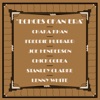
 Echoes of an Era
Echoes of an Era
2003 Elektra 73781
Original recording 1982
|
|
This all-star group features Freddie Hubbard on trumpet, Joe Henderson on tenor saxophone, Chick Corea on piano, Stanley Clarke on bass and Lenny White on drums, with R&B diva Chaka Khan on vocals. Given Khan’s history and the fusion credentials of the instrumentalists, it surprised some that this was an entirely acoustic, straight-ahead jazz album. Khan proves here to be more than capable as a jazz vocalist, and her rendition of “All of Me” is delightful.
|
|
 Sarah Vaughan
Swingin' Easy
1992 Polygram 14072
Original recording 1954
|
|
Vaughan is irresistibly swinging on this performance with the equally swinging backing of Jimmy Jones, Richard Davis and Roy Haynes. Her scat solo, meanwhile, is breathtaking in its dexterity and creativity.
|
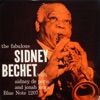
 Sidney Bechet
Fabulous Sidney Bechet
2001 Blue Note 30607
Original recording 1953
|
|
Bechet’s small group takes its time with a relaxed interpretation of “All of Me.” Of course, the relaxed tempo doesn’t stifle Bechet’s irrepressible soloing style.
|
 Erroll Garner
Erroll Garner 1949
Classics 1138
|
|
Pianist Garner gives the song a Tin Pan Alley feel on this busy but highly original reading of the song.
|
 King Pleasure
Golden Days
1991,Original Jazz Classics 1772
Original recording, 1960
|
|
This rollicking rendition highlights the vocalese talents of King Pleasure. Twisting and multiplying lyrics tenfold the singer keeps this high-energy swing going at a blistering pace.
|
 Lee Konitz
Motion (Dig)
Verve
Original Recording 1961
|
|
Alto saxophonist Konitz is his original and intriguing self on this track. Drummer Elvin Jones and bassist Sonny Dallas lay down an up-tempo base for Konitz's spellbinding, improvisational, solo runs.
|
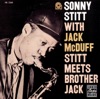
 Sonny Stitt and Jack McDuff
Stitt Meets Brother Jack
Ojc
Original recording 1962
|
|
Saxophonist Stitt and organist McDuff deliver a mid-tempo, swing rendition of the song. This laid-back reading features great horn runs over soulful organ and interesting percussion.
|
|
|
|