|
|
|
| “‘Darn That Dream’ has a very interesting and difficult melody in that its chromatic character makes the notes hard to find ... I’ve never heard a song quite like it.” |
|
 |
|
- Alec Wilder
|
|
| |
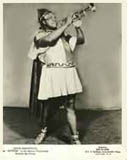
“Darn That Dream” was introduced in the Broadway musical, Swingin’ the Dream, which opened November 29, 1939, at the Center Theater. The show closed shortly thereafter, on December 9th, after only thirteen performances. Lack of talent was not its downfall. Among those who sang “Darn That Dream” in the production were Louis Armstrong (as Bottom, pictured above), Maxine Sullivan (as Tatiana, Queen of the Pixies), Bill Bailey, Dorothy Dandridge, Vivian Dandridge, and Etta Jones, the latter three billing themselves as the Dandridge sisters (as three pixies). Note: Etta Jones of the Dandridge Sisters (born 1919) is not to be confused with Etta Jones the jazz/blues vocalist (born 1928).
|
| |
| |
|
| |
|
|
| |
| |
|
| |
|
The show’s short run was a disappointment for all involved, especially the investors who lost nearly $100,000, one of the costliest failures of the time. For Benny Goodman, however, there was a residual bright spot. At the end of January “Darn That Dream,” featuring vocalist Mildred Bailey, became his first of three Top Ten pop-chart hits of 1940. “Darn That Dream” hit the charts two more times that year,
- Benny Goodman and His Orchestra (1940, Mildred Bailey, vocal, #1)
- Blue Barron and His Orchestra (1940, Russ Carlyle, vocal, #14)
- Tommy Dorsey and His Orchestra (1940, Anita Boyer, vocal, #16)
|
|
| |
|
| |
|
Besides “Darn That Dream,” Jimmy Van Heusen and Eddie De Lange wrote five other songs for Swingin’ the Dream: “Swingin’ a Dream,” “Moonland,” “Peace, Brother,” “There’s Gotta Be a Weddin’,” and “Spring Song.” Benny Goodman shares credit for the music on the latter song. “Love’s a Riddle” also appeared in the show and was written by Alec Wilder, with Van Heusen and De Lange sharing credit for the lyrics. “Darn That Dream” would be the only hit from the score.
|
| |
| |
|
| |
|
|
| |
| |
|
| |
|
Based on A Midsummer Night’s Dream and billed as a “musical comedy extravaganza,” Swingin’ the Dream was set in New Orleans in 1890. The cast of 150, mostly African American actors, singers, and musicians, included, besides those mentioned above, Ruth Ford, Dorothy McGuire, Jackie “Moms” Babley, Butterfly McQueen, the Benny Goodman Sextet, Bud Freeman and His Summa Cum Laude Orchestra, and a full orchestra conducted by Don Voorhees. Agnes DeMille choreographed the dance numbers and Walt Disney did the artwork for the sets.
Swingin’ the Dream was panned by audiences and critics alike. The morning after opening night Brooks Atkinson of the New York Times said,
It would have been better to throw Shakespeare out of the window ...Every now and then a flare of dancing breaks through the professorial patter, and the Benny Goodman boys perform brilliantly on a piece of music. But the going is heavy through the long stretches of the evening.
In 1998, the title Swingin’ the Dream was recycled for the book, Swingin’ the Dream: Big Band Jazz and the Rebirth of American Culture by Lewis A. Erenberg. The book is unrelated to the play but makes an interesting case that the Big Band Era, 1935-1948, was as relevant as the subsequent Bebop era, the former being when American popular music rid itself of the constraints of European influence. Erenberg discusses how the collaboration of African Americans and second-generation immigrants changed American culture and society.
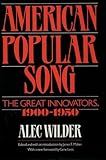
In his book, American Popular Song: The Great Innovators, 1900-1950, Alec Wilder notes hundreds of jazz standards but in the case of “Darn That Dream” injects a bit of personal history. Asked to write an entire score for Swingin’ the Dream, which he did, Wilder then had to take it back “due to the duplicitous character of the producer.” For one reason or another, his composition “Love’s a Riddle” was kept in the show. Wilder comments that when he met Van Heusen, he was inclined to dislike him because of the circumstances. Regardless of his feelings at that time, Wilder shows a genuine appreciation for Van Heusen’s music, devoting to him nearly ten pages of mostly complimentary text in his chapter titled “The Great Craftsmen.”
|
|
|
|
More information on this tune... |
|
See the Reading and Research page for this tune for additional references. |
|
- Jeremy Wilson
|
|
| This section suggests definitive or otherwise significant recordings that will help jazz students get acquainted with
“Darn That Dream.” These recordings have been selected from the Jazz History and
CD Recommendations sections.
|
Miles Davis recorded a landmark version of “Darn That Dream” in 1950 ( Birth of the Cool) as part of the “Birth of the Cool Sessions.” That performance features the vocals of bebop singer Kenny Hagood and a lush nonet arrangement by Gerry Mulligan, who would later record the tune himself. Among instrumental ballad renditions, Dexter Gordon offers one of his most lyrical ballad performances on a 1964 version recorded live in Europe ( One Flight Up). Meanwhile, George Shearing’s quintet recording with Wes, Buddy and Monk Montgomery ( George Shearing and the Montgomery Brothers) is a standout performance that is not interpreted as a ballad, instead taking the tune as a bouncy swing number.
Noah Baerman - Jazz Pianist and Educator
|
For “Darn That Dream” Jimmy Van Heusen used the
standard A-A-B-A form. Within that constraint, however,
he took chances employing a chromatic harmony, a
difficult melody and an abrupt change of key in
the bridge. Alec Wilder comments, “I’ve never heard
a song quite like it,” and offers Van Heusen’s successful
composition as proof that the public of that era,
through the complex arrangements of big bands, had
become accepting of “more daring pop tunes.”
Using Jimmy Van Heusen’s A-A-B-A form, Eddie
DeLange fit lyrics that curse a dream in which one’s
lover shows affection, a dream that never comes
true. DeLange begins all four sections with the
word “Darn,” followed by “that dream,” “your lips,”
“that one-track mind of mine” and finally “that
dream.” DeLange ends each A section with the line
“Oh, darn that dream,” appropriately closing those
sections with the song’s title and hook phrase.
In closing the bridge, DeLange makes light of
the entire situation saying, “Just to change the
mood I’m in, I’d welcome a nice old nightmare.”
The reference to the change of mood is clever, using
the turn from frustration to wry humor to coincide
perfectly with Van Heusen’s change of key. -JW
|
Musical analysis of
“Darn That Dream”
|
| Original
Key |
G major;
false key change to Eb major in the bridge |
| Form |
A1 – A2 –
B – A2 |
| Tonality |
Primarily
major |
| Movement |
“A” is essentially
an eleven-note ascending scale moving chromatically
for the first six notes, then step-wise
for the last five before descending stepwise.
The pitches are, of course, so embellished
by neighbor tones, skips and leaps, that
this is barely noticeable. “B” consists
of a number of short, step-wise motifs in
both directions. |
|
Comments
(assumed
background)
|
| At his most sophisticated, Van Heusen presents
an angelic melody that is devilishly difficult
for the novice jazz performer. Many exotic
harmonic devices are used and are wedded
to the melodic line in a way not often heard
in this genre. In the melody, D ascends
to Eb by way of an upper G, then from E
natural to F. Underneath, the chord progression
goes from the I (G major) to the bVI
(Eb), functioning almost as a German augmented
sixth chord in that it resolves to a ii7
that the ear would expect to continue on
to V7 – I. Instead, Van Heusen delays this
by going to a III7 (embellished by a ctø7
based on iiii7(b5) – necessary, because
of the melody note, a chromatic lower neighbor
of the leading tone). This, in turn, resolves
to vi, from which Van Heusen writes an exotic
harmonic progression: vi – I – II7 – iv.
This is actually ascending, but because
of the inversions created by the descending
bass line, we are tricked into hearing it
as a descending progression. The iv chord
is followed by a ctø7 functioning as a iiø7
of ii. This begins what is basically a circle-of-fifths
return to the tonic but, again, so cleverly
disguised by chord substitutions that it’s
nearly impossible to recognize it as such.
The ctø7 (Bm7(b5) in the original key) resolves
to a VI7 (E7) and from there goes to ii7
(Am7) at the start of the last phrase of
section “A”. The logical progression would
then be V7 – I (D7 – G), but, instead, Van
Heusen substitutes a bVII7 (F7) for the
V7, then, instead of going back to I, he
goes to iii (Bm7). This, of course, requires
another circle of fifths in order to return
comfortably to I, which is exactly what
Van Heusen does (no substitutions this time,
but several chord extensions). After such
an exotic, winding trip down tonal paths
seldom heard, the contrasting simplicity
of section “B” is almost a relief. The modulation
from the first key to the second is fairly
direct, using I – vii7 – III7 in which the
vii7 becomes the pivotal ii7 of the new
key (in the original, G – Fm7 – Bb7, winding
up in Eb major). Section “B” consists of
two old stand-bys: I – vi – ii7 – V7 in
the first two-measure phrase, followed by
iii – VI7(b9) – ii7 – V7 in the consequent
phrase. The first phrase is repeated, but
then the ear is warned of a change when
the iiii’s are suddenly “tonicized” by a
brief VII7 (V7/I in the new temporary key
– Gm –D7 – Gm). Indeed, the song has returned
to the parallel minor of the original key,
but most listeners do not realize it until
the following ii7 followed byV7 preceded
by an embellishing +6 chord (Am – Eb7 –
D7).
This song is one requiring a fair amount
of study and preparation. The head should
be learned thoroughly, and initial improvisations
should focus on melodic embellishment (no
easy task with a complicated melodic line
like this one). |
|
K. J. McElrath - Musicologist for JazzStandards.com |
|
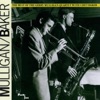
Gerry Mulligan (baritone sax) and Chet Baker
(trumpet), members of the West Coast “Cool” school
of jazz, collaborated for about a year in an unusual
group with a rhythm section of just string bass
and drums---no chord instrument (guitar or piano).
It was a radical approach that produced elegant
results. The interplay achieved between Baker (then
only 22) and Mulligan is distinctive and shows that
they had a special ability to spontaneously create
fine, improvised music. They were especially drawn
to well-written popular songs, as their recording
of “Darn That Dream” illustrates.
Although both Mulligan and Baker would go their
separate ways, the music they achieved together
would be, in some regards, the best of their careers.
Chris Tyle - Jazz Musician and Historian
|
Additional information for "Darn That Dream" may be found in:
|
|
|
 Robert Gottlieb, Robert Kimball
Reading Lyrics
Pantheon
Hardcover: 736 pages
(Includes the following types of information: song lyrics.)
|
|
|
|
|
“Darn That Dream” was included in these films:
- Alice (1990, Thelonious Monk)
- Criminal (2004, Clifford Brown,
Max Roach Quintet)
|
|
|
|
Comment Policy
- Your comments are welcome, including why you like
this tune, any musical challenges it presents, or additional background information.
- Jazz musicians, fans, and students of all ages use this website as an educational resource.
As such, off-topic, off-color, unduly negative, and patently promotional comments will be removed.
- Once submitted, all comments become property of JazzStandards.com.
By posting, you give JazzStandards.com permission to republish or otherwise distribute your comments in any format or other medium.
JazzStandards.com reserves the right to edit or remove any comments at its sole discretion.
|
|
| Click on any CD for more details at Amazon.com |
 Miles Davis
Birth of the Cool
Blue Note Records
|
|
This tune comes from the Miles Davis sessions that are credited with ushering in the era and style of cool jazz. Interestingly, though, Davis does not solo on this tune. Instead, the featured voice is that of vocalist Kenny “Pancho” Hagood, whose singing is lushly backed by Gerry Mulligan’s arrangement.
|
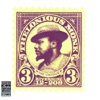
 Thelonious Monk
The Unique Thelonious Monk
1991 Original Jazz Classics 64
Original recording 1956
|
|
This lyrical (though Monkishly angular) ballad performance features Oscar Pettiford and Art Blakey. These sessions of standards were part of producer Orrin Keepnews’ plan to help build Monk’s audience, a process that subsequently led to the unveiling of some of Monk’s more complex original music.
|
 George Shearing
George Shearing and the Montgomery Brothers
1991 Original Jazz Classics 40
Original recording 1961
|
|
Shearing popularized the sound of melodies played together by piano, guitar and vibraphone. On this one-time collaboration, Wes Montgomery covers the guitar, with his brothers Buddy on vibes and Monk on bass. The CD features two swinging takes of this tune, which features some of Shearing’s famous unison melodies and block chord soloing after an opening portion in which the three lead instruments play in counterpoint.
|
|
 Nancy Wilson
But Beautiful
Blue Note Records
Original recording 1969
|
|
Vocalist Wilson gives this tune a gentle, lighthearted interpretation. The beauty of her singing is matched by her all-star band, which centers around pianist Hank Jones.
|
 Dexter Gordon
One Flight Up
2004 Blue Note 84176
Original recording 1964
|
|
Gordon is one of the most noteworthy interpreters of ballads that jazz has known, and his breathtakingly lyrical reading of “Darn That Dream” is definitive even by his lofty standards. This performance, recorded in Europe, features fellow expatriates Kenny Drew and Art Taylor along with Danish teenager Niels-Henning Orsted Pedersen.
|
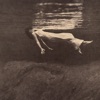
 Bill Evans, Jim Hall
Undercurrent
Blue Note Records
|
|
There is a quiet understanding on this duet from guitarist Jim Hall and pianist Bill Evans. The musicians manage to weave two very independent streams into one solitary voice.
|
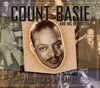
 Count Basie & His Orchestra
America's #1 Band
Sony
Original Recording 1950
|
|
This live radio broadcast features a charming vocal turn by Helen Humes. If you listen closely, you can hear some wonderful playing by saxophonist Lester Young while Humes sings.
|
 Art Pepper, George Cables
Tete-A-Tete
Ojc
|
|
This is one of the last recordings of alto saxophonist Art Pepper, fittingly done with his friend and regular band mate, pianist George Cables. The camaraderie is readily apparent and propels the song to a higher level.
|
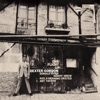
 Kenny Dorham Quintet
Kenny Dorham Quintet
1993 Original Jazz Classics 113
Original recording 1953
|
|
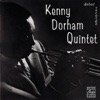
This album features two takes of the “Darn That Dream,”’ both straight-ahead readings. Dorham’s lyrical trumpet is crystalline and pure, and the emotion is palpable.
|
 Dianne Reeves
A Little Moonlight
2003 Blue Note
|
|
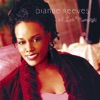
Vocalist Reeves delivers a beautiful rendition of “Darn That Dream,” an elegant and dreamy effort with accompaniment by guitarist Romero Lubambo.
|
|
|
|