|
|
|
| Louis Armstrong’s version from 1930 is a tour-de-force, giving us a brief, three-minute glimpse of what his extended live versions must have been like. |
|
 |
|
- Chris Tyle
|
|
| |
Eddie Cantor starred in producer Florenz Ziegfeld’s musical Kid Boots which opened on Broadway on December 31, 1923 and ran to February 21, 1925. The music for the show was written by Harry Tierney and Joe McCarthy. However, during the show’s run the song “Dinah” by Sam M. Lewis, Joe Young and Harry Akst was added to the finale and sung by Cantor, becoming the hit of the show. But it was vocalist Ethel Waters who is responsible for popularizing the tune. She is often credited with introducing it because she performed it in a nightclub show from 1925, Plantation Revue, and the tune took off like wildfire the next year with her recording reaching the second spot in the charts:
- Ethel Waters (1926, vocal, #2)
- The Revelers (1926, #4)
- Cliff Edwards (1926, vocal, #5)
- Fletcher Henderson (1926, #13)
- Ted Lewis and His Orchestra (1930, #13)
- Bing Crosby and the Mills Brothers (1932, vocal, #1)
- Boswell Sisters (1935, vocal, #3)
- Fats Waller and His Rhythm (1936, vocal, #7)
- Sam Donohue and His Orchestra (1946, #9)
|
|
| |
|
| |
|
The Plantation Revue, staged at the Plantation Club at Broadway and 50th Streets in New York, had been featuring the popular actress Florence Mills. But during the summers Mills would tour, leaving the oppressive heat and humidity of New York behind. The owners of the Plantation planned a new show for the summer, auditioning and hiring vocalist/actress Ethel Waters as the star. Waters’ autobiography, His Eye Is on the Sparrow, tells the tale regarding how “Dinah” came to be in the show.
|
| |
| |
|
| |
|
|
| |
| |
|
| |
|
Songwriters Joe Young and Harry Akst brought her the number, playing it for her at a bright tempo. Waters asked if that was the way they expected her to do it. Surprised, they said, “Why not sing it your way?” Waters took the tune home and worked on it with her accompanist, creating a moving version at a much slower tempo, similar to the approach she would use for a blues. She sang the song for both songwriters and producer Sam Salvin and landed the role.
|
| |
| |
|
| |
|
When Florence Mills returned in the fall of 1925, Waters worked for a short time with a traveling version of the Plantation Revue. The next year she was hired for the show Africana, where she introduced the tune “I’m Coming, Virginia” and reprised her hit from 1925, “Dinah.”
The collaboration of Waters with composer Akst was responsible for another hit, “Am I Blue,” from 1929 which became Waters’ first number one recording.
Bing Crosby’s 1932 recording paired him with the newly formed singing group the Mills Brothers. Crosby had recorded with them briefly as part of a medley of music from the show George White’s Scandals. Bing liked the group and wanted to record with them, but the conservative management of Brunswick Records would undoubtedly have nixed the idea. So Bing slyly showed up during a Mills Brothers recording session and had the engineers make a “test” recording for his own use. A short time later Crosby played the test for the Brunswick execs, who realized how good it was and released it on the flip side of Crosby’s version of “Can’t We Talk it Over.” It soared to number one, the first such hit for the Mills Brothers. It was possibly the first time an African-American vocal group had been recorded with a white singer, and to quote the great clarinetist Artie Shaw, “Bing Crosby...was the first hip white person in American.”
|
|
|
|
More information on this tune... |
|
|
 Henry Martin
Enjoying Jazz
Schirmer Books
Paperback: 302 pages
(Martin offers a musical analysis “Dinah” and discusses its performers.)
|
|
|
|
See the Reading and Research page for this tune for additional references. |
|
Chris Tyle - Jazz Musician and Historian
|
|
| This section suggests definitive or otherwise significant recordings that will help jazz students get acquainted with
“Dinah.” These recordings have been selected from the Jazz History and
CD Recommendations sections.
|
Vocalist Ethel Waters was the first to make a major impact with “Dinah,” thanks to her classic 1925 recording of the song (An Introduction to Ethel Waters). Another approach can be heard in the hugely popular 1931 rendition by Bing Crosby with the Mills Brothers (Jazz Singer 1931-1941). Among the many significant instrumental versions, we can hear a little bit of everything in Pee Wee Russell’s all-star performance from 1938 (His Best Recordings).
Noah Baerman - Jazz Pianist and Educator
|
The “Dinah” lyrics were typical, southern-belle, Tin Pan Alley fodder. The verse tells us “Carolina brought us ‘Dinah’,” and then the chorus explains how wonderful she is with her “Dixie eyes blazing,” then how one would “wander to China” or “hop an ocean liner” to be with “Dinah Lee.” Chris Tyle
Musical analysis of “Dinah” | | Original Key | Ab major - tonal shift to relative minor in “B” | | Form | A1 - A2 - B - A3 | | Tonality | “A” is major throughout; “B” is minor. | | Movement | “A” is built on a rising and falling pentatonic scale; three-note rising chromatic run into “B” based on a “Charleston” figure built on an interval of a major descending third. | Comments (assumed background) | | Harmonically, this tune is simple; “A” goes from I to V7 and back, with a I - iii°7 - ii7 - V7 turnaround at the end of the first “A” and a plagal (IV - I or “amen” cadence) at the end of “A2.” “B” is really the minor variation of the same, but there are some descending and ascending embellishments that add harmonic interest and facilitate the modulation back into the major key. | | K. J. McElrath - Musicologist for JazzStandards.com |
|
One of the most popular tunes of jazz musicians prior to World War II, “Dinah” was recorded by almost every jazz player from Louis Armstrong to Clarence Williams. Two interesting versions from January, 1926, recorded two days apart, feature Coleman Hawkins on bass sax (an instrument he vehemently denied playing) with Clarence Williams and then with Fletcher Henderson.
A session led by cornetist Red Nichols from 1929 features up-and-coming jazz players Jack Teagarden on trombone and Benny Goodman on clarinet, both of whom were working with drummer Ben Pollack’s band.
Louis Armstrong’s version from 1930 is a tour-de-force, giving us a brief, three-minute glimpse of what his extended live versions must have been like. There’s also a splendid film version of Armstrong from 1933 in Copenhagen, his first film appearance.
Chris Tyle - Jazz Musician and Historian
|
Additional information for "Dinah" may be found in:
|
|
|
 Thomas S. Hischak
The Tin Pan Alley Song Encyclopedia
Greenwood Press
Hardcover: 552 pages
(1 paragraph including the following types of information: anecdotal, film productions, history and performers.)
|
|
|
|
|
 Robert Gottlieb, Robert Kimball
Reading Lyrics
Pantheon
Hardcover: 736 pages
(Includes the following types of information: song lyrics.)
|
|
|
|
|
Henry Martin
Enjoying Jazz
Schirmer Books
Paperback: 302 pages
(3 paragraphs including the following types of information: music analysis and performers.)
|
|
|
|
|
|
|
|
Comment Policy
- Your comments are welcome, including why you like
this tune, any musical challenges it presents, or additional background information.
- Jazz musicians, fans, and students of all ages use this website as an educational resource.
As such, off-topic, off-color, unduly negative, and patently promotional comments will be removed.
- Once submitted, all comments become property of JazzStandards.com.
By posting, you give JazzStandards.com permission to republish or otherwise distribute your comments in any format or other medium.
JazzStandards.com reserves the right to edit or remove any comments at its sole discretion.
|
|
| Click on any CD for more details at Amazon.com |
 Bing Crosby
Jazz Singer 1931-1941
Retrieval Records
Original recording 1931
|
|
Neither Bing Crosby nor the Mills Brothers tend to be the first names mentioned when discussing jazz vocalists, but this version of “Dinah,” in addition to being historically significant, is exceptionally swinging!
|
 Django Reinhardt
The Very Best of 1934-1939
Mastercuts Lifestyle
Original recording 1934
|
|
With his Quintette du Hot Club de France, featuring the great violin of Stephane Grappelli, guitarist Reinhardt offers up some of his most creative and authoritative playing on this version of “Dinah.”
|
 Fats Waller
If You Got to Ask, You Ain't Got It!
RCA Victor
Original recording 1935
|
|
Pianist Waller, in addition to playing an excellent boogie-inspired piano solo, offers a very appealing vocal rendition of “Dinah.” Herman Autrey’s trumpet is also a standout.
|
Pee Wee Russell
His Best Recordings: 1927-1944
Best of Jazz
Original recording 1938
|
|
Clarinetist Russell was associated with early jazz, recorded this song during the swing era, and as was typical of his career, produced era-defying results. His playing is wonderful, as is that of his all-star band, including Dicky Wells on trombone, James P. Johnson on piano and Freddie Green, who takes full advantage of a rare soloing opportunity on guitar.
|
 Thelonious Monk
Solo Monk
Sony
Original recording 1964
|
|
“Dinah” hasn’t been a frequently recorded tune in the post-bop era, but a notable exception to this can be found on this solo piano recording, as Monk combines his characteristic angularity with his stride roots.
|
|
 Ethel Waters
Am I Blue?
ASV Living Era 5290
Original recording 1925
|
|
Waters sets an early standard that would be almost impossible to match. Hers is simply one of the finest vocal renditions of this song. Her powerful voice, over the top of a lazy swing tempo, allows her a bluesy reading that renders the wonderful lyrics with precision.
|
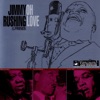
 Jimmy Rushing
Oh Love
1999 Vanguard Records 79606) Collection of mid-‘50s recordings
|
|
Up-tempo, boisterous fun characterizes one of the greatest male jazz vocalists of all time. Rushing swings this one hard, daring the band to keep up with him as they chase him up and down the verses.
|
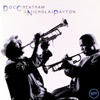
 Doc Cheatham/Nicholas Payton
Doc Cheatham & Nicholas Payton
1997 Verve 314537062
Original recording 1997
|
|
A rollicking, infectious blast is had as the old guard makes way for the new. Both trumpeters are at the top of their game, and it is hard to tell who is having more fun, the student or the master.
|
|
|
|