|
|
|
| |
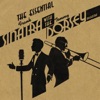
“Ol’ Blue Eyes,” Frank Sinatra, introduced “Everything Happens to Me” in 1941 with Tommy Dorsey’s orchestra, and their rendition rose to number nine on the charts.
|
|
| |
|
| |
|
Composer Matt Dennis became acquainted with Dorsey through his friend, vocalist Jo Stafford. He went to see her perform with the bandleader at the Hollywood Palladium in December, 1940. Stafford introduced Dennis to Dorsey, who asked to hear some of his tunes. Dorsey liked what he heard, remarking, “They’re wonderful! How would you like to write for me? We’ll record them.”
|
| |
| |
|
| |
|
Although Dennis had music for the tunes, they needed lyrics. One evening, while playing a nightclub gig in Los Angeles, Dennis was approached by Tom Adair, who asked if he could write a song with him. Adair was answering phones for the power company in Los Angeles and writing poems in his spare time for the Saturday Evening Post but had already written lyrics to one of Dennis’ numbers, “Will You Still Be Mine?” Dennis was elated with Adair’s sophisticated lyrics and asked him to write words for his other compositions, “Everything Happens to Me” and “Let’s Get Away from It All.” Dorsey recorded all of them in February, 1941.
|
| |
| |
|
| |
|
“Everything Happens to Me” was the first of Dennis’ compositions recorded by Sinatra and Dorsey. In an interview for the 1995 Sony CD set Frank Sinatra: The Best Of The Columbia Years 1943-1952, Dennis said, “Sinatra had such a natural sound to his voice. I think his renditions of my songs are just fantastic--he knew my style and sang them much the same way that I’d sing them. How could there be anyone to make me sound better?” Sinatra would record a number of Dennis’ tunes, and his 1953 recording of “Angel Eyes” made the charts.
Adair’s lyric is a study in self-deprecation, written about a person for whom everything goes wrong. The rain ruins a golf game, the upstairs neighbor complains about the noise from a party, then there are measles, mumps and missed trains. On a live recording from the Tally-Ho Club in Los Angeles, Dennis includes some pithy lyrics describing the pitfalls of working in a nightclub: “I try to sing a song and then the conversation flows, so I sing a little stronger and then the Waring mixer goes, then to top it off somebody has to blow his nose.” When Dennis passed away in 2002, NPR’s Fresh Air radio host Terry Gross included this version in her tribute to Dennis.
|
|
|
|
|
Musical analysis of “Everything Happens to Me”
|
|
Original Key
|
Bb major
|
|
Form
|
A1 - A2 - B - A3
|
|
Tonality
|
Primarily major
|
|
Movement
|
Generally descending via a pattern that rises a step then skips down a 3 rd before arpeggiating back up.
|
|
Comments (assumed background)
|
|
Rhythmically, there is little interest here; this tune was primarily a vehicle for the lyric. The harmonic progression of “A” is essentially a big ii7 - V7 - I cadence with several delaying embellishments added and an N6 substitution for the last V7 to add interest. The first six measures of “B” are noteworthy, especially in light of the composer’s identity. Although in a different key and disguised by the style and context, the chord progression here is nearly identical to “Angel Eyes,” another tune by Matt Dennis. However, this tune predates “Angel Eyes” by six years.
|
|
K. J. McElrath - Musicologist for JazzStandards.comle style="width: 100%" cellpadding="10" border="1">
|
|
Musical analysis of “Everything Happens to Me”
|
|
Original Key
|
Bb major
|
|
Form
|
A1 - A2 - B - A3
|
|
Tonality
|
Primarily major
|
|
Movement
|
Generally descending via a pattern that rises a step then skips down a 3 rd before arpeggiating back up.
|
|
Comments (assumed background)
|
|
Rhythmically, there is little interest here; this tune was primarily a vehicle for the lyric. The harmonic progression of “A” is essentially a big ii7 - V7 - I cadence with several delaying embellishments added and an N6 substitution for the last V7 to add interest. The first six measures of “B” are noteworthy, especially in light of the composer’s identity. Although in a different key and disguised by the style and context, the chord progression here is nearly identical to “Angel Eyes,” another tune by Matt Dennis. However, this tune predates “Angel Eyes” by six years.
|
|
K. J. McElrath - Musicologist for JazzStandards.com
|
|
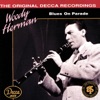
Woody Herman’s “Pre-First Herd” recording from 1941 features his critically approved vocal styling. First Herd trombonist Bill Harris, a uniquely masterful musician, did a fine version of the tune on his second recording session as a leader in 1946 (which is unavailable), but a live version from 1952 is a more interesting performance. That same year, composer Matt Dennis, a sadly under-recorded pianist and singer now remembered mostly for his excellent compositions, created a marvelous rendition that is unfortunately out-of-print, but a 1958 live recording is available.
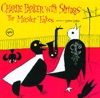
The version that probably solidified the tune in the jazz repertoire was that by alto saxophonist Charlie Parker on his famous Charlie Parker with Strings recording from 1949. But also worth investigating is a much-reissued live recording of Stan Getz’s Quintet from Boston’s Storyville Club in 1951 as well as the 1952 version of Charlie Parker-influenced alto sax player Art Pepper.
Chris Tyle - Jazz Musician and Historian
|
Additional information for "Everything Happens to Me" may be found in:
|
|
|
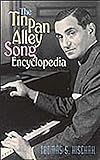 Thomas S. Hischak
The Tin Pan Alley Song Encyclopedia
Greenwood Press
Hardcover: 552 pages
(1 paragraph including the following types of information: performers and style discussion.)
|
|
|
|
|
|
|
|
Comment Policy
- Your comments are welcome, including why you like
this tune, any musical challenges it presents, or additional background information.
- Jazz musicians, fans, and students of all ages use this website as an educational resource.
As such, off-topic, off-color, unduly negative, and patently promotional comments will be removed.
- Once submitted, all comments become property of JazzStandards.com.
By posting, you give JazzStandards.com permission to republish or otherwise distribute your comments in any format or other medium.
JazzStandards.com reserves the right to edit or remove any comments at its sole discretion.
|
|
| Click on any CD for more details at Amazon.com |
 Chet Baker
Chet Baker Sings It Could Happen to You
Ojc
Original recording 1958
|
|
Baker sings and plays “Everything Happens to Me” as though it had been written with him in mind. This gentle masterpiece stands as one of his signature ballad performances.
|
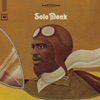
 Thelonious Monk
Solo Monk
Sony
Original recording 1964
|
|
Alone at the piano, Monk gives “Everything Happens to Me” an appropriately edgy interpretation five years after his first solo piano recording of the tune. His playful and sometimes dissonant interjections do not obscure the song, however, and this stands as one of the song’s most moving instrumental interpretations.
|
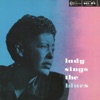
 Billie Holiday
Lady Sings the Blues: The Billie Holiday Story, Vol.4
Polygram Records
Original recording 1955
|
|
Holiday, accompanied with sensitivity by clarinetist Tony Scott and his band, is wonderfully suited for this tune. Not surprisingly, she gets deep inside the song, injecting a compelling mixture of pathos and irony.
|
 Sonny Rollins
Sonny Rollins on Impulse!
Grp Records
Original recording 1965
|
|
Rollins treats us to an angular reading of the melody and a lengthy improvisation on this classic example of his sound in the mid-1960s. Pianist Ray Bryant and bassist Walter Booker are given room to stretch out as well.
|
|
 Danilo Perez
PanaMonk
1996 Impulse! 190
Original recording 1996
|
|
In a highly stylized, energetic reading of the song by the Panamanian pianist, Perez conjures up the spirit and sensibilities of the great Monk, hitting the keys with force and authority.
|
 Branford Marsalis
Bloomington
1991 Columbia 52461
Original recording 1991
|
|
This exceptional hard bop reading is from a live date in Indiana. Technique meets invention as saxophonist Marsalis reconfigures the song to respond to the many challenges he sets for himself and his band mates.
|
 John Pizzarelli/George Shearing
The Rare Delight of You
2002 Telarc Jazz Zone 83546
Original recording 2002
|
|
Guitarist/singer Pizzarelli abandons his usual crooning style to “talk” through this one. That style, coupled with Shearing’s elegant piano, lends a refined, nostalgic feeling to the song.
|
 Claire Martin
The Waiting Game
1996 Linn Records 5018
Original recording 1991
|
|
This native of Scotland was a full formed jazz vocalist when she recorded this, her debut CD. She gives this plaintive ballad a simple treatment with only piano accompaniment and a guitar interlude.
|
|
|
|