|
|
|
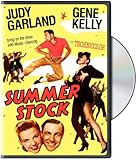
| Actress/vocalist Judy Garland revived “Get Happy” when she performed it as a striking song and dance number in the 1950 film Summer Stock.... |
|
 |
|
- Chris Tyle
|
|
| |
Vocalist Ruth Etting introduced “Get Happy” in the Broadway show 9:15 Revue in 1929. The next year the song landed in the charts:
- Nat Shilkret and the Victor Orchestra (1930, Phil Dewey, Frank Luther, Leo O’Roarke, vocal, #6)
- Frankie Trumbauer and His Orchestra (1930, vocal, #15)
|
|
| |
|
| |
|
“Get Happy” was the first collaboration of Harold Arlen and Ted Koehler. Meeting in the Remick publishing office in New York, Arlen played his untitled composition on the piano for Koehler. According to Edward Jablonski’s biography, Harold Arlen: Rhythm, Rainbows & Blues, Koehler realized that Arlen “...was a born musician, a superb pianist with a gift for composition.” After Arlen’s performance, Koehler began formulating lyrics for the song.
|
| |
| |
|
| |
|
|
| |
| |
|
| |
|
The piece contained a repeated rhythmic figure that suggested the words “Get Happy” to Koehler, who knew that the phrase came from the African-American gospel music tradition and referred to the experience of receiving the Holy Spirit during a church service. The remainder of the lyrics to the tune unfolded as a sort of pseudo-spiritual.
Singer Ruth Etting was an acquaintance of Koehler, and when Etting heard the song she found a spot for it in her next show, the 9:15 Revue. Although the revue floundered, the tune gathered momentum, and Remick released the sheet music with Etting on the cover. (Oddly, she never recorded the tune).
Actress/vocalist Judy Garland revived “Get Happy” when she performed it as a striking song and dance number in the 1950 film Summer Stock, her last film for Metro-Goldwyn-Mayer.
Over time the tune’s appeal was more with musicians than singers who found it a challenge because of the many interval jumps and the tricky lyrics. The verse, which is seldom played anymore, is minor, and the chorus, major, creating a superbly dramatic effect. The sermon-like lyrics exclaim “pack up your troubles, c’mon get happy” and “the Lord is waiting to take your hand, we’re going to the promised land.”
|
|
|
|
| This section suggests definitive or otherwise significant recordings that will help jazz students get acquainted with
“Get Happy.” These recordings have been selected from the Jazz History and
CD Recommendations sections.
|
Saxophonist Coleman Hawkins is responsible for one of the first important recordings of “Get Happy,” courtesy of his 1943 performance (Jazz on the Road), taken at a swinging, relaxed tempo and featuring the innovative bass work of Oscar Pettiford. Pianist Bud Powell upped the ante on an influential 1950 recording (Jazz Giant) that also demonstrated the bright tempo often associated with the song thereafter. Ella Fitzgerald’s vocal performance from 1960 (Arlen Songbook Vol. 2) is very appealing and is an excellent source from which to learn the melody and lyrics.
Noah Baerman - Jazz Pianist and Educator
|
Musical analysis of “Get Happy” | | Original Key | Eb major, shifting temporarily to Ab major during “A2” | | Form | A1 - A2 - B - A1. “A2” is in the subdominant key but is otherwise virtually identical to “A1”; in the original version, “B” remains in Ab major before returning to the tonic | | Tonality | Major throughout | | Movement | “A” sections consist of ascending arpeggios followed by descending scale fragments and a downward third; “B” is a series of descending fourths. | Comments (assumed background) | | Most of “A” stays on I and V7; breaking the potential monotony is perhaps Arlen’s reason for shifting keys during the second “A.” In Arlen’s original score “B” remains in the new key. The changes go from I -IV then drop a half step before starting a “circle-of-fifths” progression back to Eb (this actually happens twice, delayed by a deceptive resolution in measure 4 of “B”). Today, a number of players perform this section in the starting key of the song, giving it a strong “Dorian” flavor; however, the original is preferable. | | K. J. McElrath - Musicologist for JazzStandards.com |
|
Coleman Hawkins’ session from December, 1943, has been mentioned before on the Jazz Standards pages and with good reason: it’s one of the best in his long career. Accompanied by bassist Oscar Pettiford, pianist Eddie Heywood, Jr., and drummer Shelly Manne, Hawkins’ performance on the medium-tempo “Get Happy” is a joy.
In another stellar recording session (from 1945), vibraphonist Red Norvo assembled a group including boppers Dizzy Gillespie (trumpet) and Charlie Parker (alto sax), along with swing mainstays Slam Stewart (bass), Teddy Wilson (piano) and Flip Phillips (tenor sax). The results were top-drawer swing/bop. (The CD listed contains two takes.)
Bop trombonist J. J. Johnson’s all-star date from 1953 brought together the rhythm section from the Modern Jazz Quartet (John Lewis on piano, Percy Heath on bass and Kenny Clarke on drums) with tenor saxophonist Jimmy Heath and fabulous trumpeter Clifford Brown with sparkling results. (The CD listed contains two takes.)
Chris Tyle - Jazz Musician and Historian
|
Additional information for "Get Happy" may be found in:
|
|
|
 David Ewen
Great Men of American Popular Song
Prentice-Hall; Rev. and enl. ed edition
Unknown Binding: 404 pages
(1 paragraph including the following types of information: history.)
|
|
|
|
|
 Thomas S. Hischak
The Tin Pan Alley Song Encyclopedia
Greenwood Press
Hardcover: 552 pages
(1 paragraph including the following types of information: film productions, history and performers.)
|
|
|
|
|
|
|
|
Comment Policy
- Your comments are welcome, including why you like
this tune, any musical challenges it presents, or additional background information.
- Jazz musicians, fans, and students of all ages use this website as an educational resource.
As such, off-topic, off-color, unduly negative, and patently promotional comments will be removed.
- Once submitted, all comments become property of JazzStandards.com.
By posting, you give JazzStandards.com permission to republish or otherwise distribute your comments in any format or other medium.
JazzStandards.com reserves the right to edit or remove any comments at its sole discretion.
|
|
| Click on any CD for more details at Amazon.com |
 Art Tatum
Art Tatum's Finest Hour
Polygram Records
Original Recording 1940
|
|
Pianist Tatum plays “Get Happy” solo here, and he impressively toys with the song in spite of the fast tempo, as is typical of his solo work.
|
 Bud Powell
Jazz Giant
Polygram Records
|
|
This is one of the definitive moments of pianist Bud Powell’s career, which by association makes it a landmark moment in the history of bebop. Accompanied by bassist Curly Russell and drummer Max Roach, Powell takes “Get Happy” at a very bright tempo and flows through his solo with tremendous creativity and dexterity.
|
 Jimmy Smith
Live at the Baby Grand 2
Blue Note Records
Original Recording 1956
|
|
Organist Smith made this recording live with guitarist Thornell Schwartz and drummer Donald Bailey, though the focus is largely on Smith himself. The tempo is bright and they swing hard, with Smith offering an absolutely stunning solo as well as a remarkable cadenza at the end.
|
 Sonny Rollins
Night at the Village Vanguard
Blue Note Records
Original Recording 1957
|
|
Saxophonist Rollins plays a great version of “Get Happy” on this live recording with a piano-less trio featuring Elvin Jones on drums and Wilbur Ware on bass. The tempo is burning-fast and Rollins’ playing is endlessly fluid and inventive.
|
 Ella Fitzgerald
Arlen Songbook 2
Polygram Records
Original Recording 1960
|
|
Billy May’s arrangement is often brash here, but after a slow statement of the verse, a relaxed medium tempo is established. Fitzgerald’s singing is assured and swinging, and saxophonist Plas Johnson contributes a nice tenor solo.
|
|
 Mal Waldron
Mal/4Trio
1995 Original Jazz Classics 1856
Original recording 1959
|
|
Pianist Waldron plays like a man possessed on this supercharged, hyper-tempo reading of the song. His dramatic runs and fleet fingers are reminiscent of the great Bud Powell.
|
 J.J. Johnson
The Eminent Jay Jay Johnson Vol. 1
Blue Note Records 32143
original recording 1953
|
|
This appropriately joyous rendition is from one of the finest of jazz trombonists and his stellar ensemble. The driving force of the rhythm section and fantastic solos from the likes of Johnson, saxophonist Jimmy Heath, and trumpeter Clifford Brown make this one a classic.
|
 Brad Mehldau
Anything Goes
2004 Warner Bros Records 48608
|
|
Pianist Mehldau presents a very engaging, highly original interpretation of the song. Atmospheric and quirky, it is a standard turned inside out, barely recognizable but familiar nonetheless.
|
 June Christy
The Jazz Sessions: The Best of June Christy
Blue Note Records 53922
Original Recording 1962
|
|
Christy was one of the finest jazz vocalists of her era and she was always surrounded by the best musicians and arrangers, so you can bet that “Get Happy” gets the full treatment here along with 17 other standards.
|
|
|
|