|
|
|
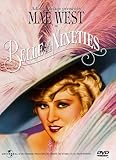
| “Mae West does ‘My Old Flame’ in full insinuando backed at one point by gorgeous Ellington voicings for clarinets...in the 1934 film Belle of the Nineties.” |
|
 |
|
- Doug Ramsey, Jazz Journalist
|
|
| |
Actress/vocalist Mae West, expertly accompanied by Duke Ellington’s Orchestra, introduced Arthur Johnston and Sam Coslow’s number “My Old Flame” in the 1934 motion picture Belle of the Nineties. West’s career had begun in vaudeville, continued onto the Broadway stage, and then into films. She was riding on the crest of a popularity wave from her film appearances when production began in 1934 for the Paramount Studios picture It Ain’t a Sin. In addition to acting and singing in the film, West contributed the story and was heavily involved in casting, direction, and production duties (although she was not officially given credit for any of these). At that time she was one of the few actresses to be given such wide artistic control.
|
| |
| |
|
| |
|
|
| |
| |
|
| |
|
West’s brand of sexual innuendo was her stock-in-trade, and the initial version of the film was deemed morally unacceptable by a representative from the Motion Picture Producers and Distributors of America (known as the Hays office for its chief, Will Hays). After a title change and a rewrite, the film was released as Belle of the Nineties.
West had long been a fan of Duke Ellington, insisting that Ellington and his orchestra appear in the film. Although Paramount executives lamely balked that he was too expensive, West got her way. Duke and company expertly accompanied West on several numbers in the film. Employed as house composers for Paramount, Coslow and Johnston had written a number of excellent songs for Bing Crosby films and had scored another hit in 1934 with the tune “Cocktails for Two,” written for the film Murder at the Vanities which also featured the Ellington ensemble.
West was no great vocalist, but, as was the case with many ex-vaudevillians and Broadway stars, she knew how to “put a song over.” Variety magazine praised her performance, commenting that Ellington’s accompaniment was a “natural for Mae West.” One of West’s biographers, Maurice Leonard in his book Mae West: Empress of Sex, commented, “She sings the best she ever did on film.”
Unfortunately Ellington’s soundtrack version is much abbreviated when compared to the rendition he recorded for Victor in May, 1934. Yet the film undoubtedly helped sales of Duke’s recording.
The tune never really caught on in a big way with the public and never hit the charts. But a 1947 recording by musical funster Spike Jones and his City Slickers was certainly popular, and, like many of his recordings, sold well and continues to be available in reissue packages.
|
|
|
|
Knowing West’s involvement with the film and her lightly-veiled eroticism, one wonders if she had some input into Coslow’s lyrics. Lines such as “I can’t even think of his name” and “my new lovers all seem so tame” almost seem to suggest a one-night stand of years before. Pretty heady stuff for 1934 audiences.
- Chris Tyle
Musical analysis of “My Old Flame” | | Original Key | G major. False key change to Bb major in“B” section. | | Form | A - A - B - A | | Tonality | Major throughout | | Movement | Primarily arpeggiated; upward skips of a third followed by wide downward leaps. Some scale-wise movement provides variety and interest. | Comments (assumed background) | | The construction of this melody--both tonally and rhythmically--is an excellent study in balance through use of contrast. “A” begins slowly, with soaring intervals, then picks up rhythmic speed with eighth-note passages moving scale-wise in mm. 4-6 before returning to half-note leaping motion in mm. 7-8. “B,” in contrast, is fairly busy, consisting of eighth notes moving mostly in 2nds and 3rds. Harmonically the first four measures bear a similarity to “A Foggy Day,”
except for the decorative “iv” chord (C minor in the original) that delays the V7 in the opening I - iiiø-V7/vi progression. The last four measures of “A,” however, make novel use of the circle of fifths, as the tonic (G7) goes to the subdominant (C7), commencing a chain that ultimately winds up on what could be called a “Neapolitan” chord (Ab7), except that the final resolution to the tonic is delayed by a ii7 - V7 in the first ending. The modulation to Bb in the second ending is a refreshing surprise to the ear, as the iv chord in the original key
becomes a ii7 in the new key. The initial chord progression of “B” is somewhat reminiscent of “Come Rain or Come Shine,” except for the G7 chord in the fourth measure and the Eb chord in the last half
of the sixth measure. This is followed by a surprise half-step movement upward, beginning the modulation back to the original key. | | K. J. McElrath - Musicologist for JazzStandards.com |
|
Although introduced by Duke Ellington and actress Mae West in the 1934 movie Belle of the Nineties, Duke’s Victor recording from May, 1934, features his regular vocalist, the incomparable Ivie Anderson.
Ellington trumpeter Cootie Williams reprised the number ten years later with a small group that included bop pianist Bud Powell and tenor saxophonist Eddie “Lockjaw” Davis. (The session was Powell and Davis’ second recording session.) Powell would go on to be one of the major pianists of the early bop period, while Davis would later gain fame in the 1950s with Count Basie.
Basie trombonist Benny Morton, along with former Ellington sidemen clarinetist Barney Bigard and saxophonist Ben Webster, did a stunning, small band version for Blue Note in 1945.
Chris Tyle - Jazz Musician and Historian
 Ben Webster
Big Ben
Proper Box (UK) 1037
|
|
|
|
|
Additional information for "My Old Flame" may be found in:
|
|
|
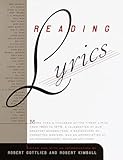 Robert Gottlieb, Robert Kimball
Reading Lyrics
Pantheon
Hardcover: 736 pages
(Includes the following types of information: song lyrics.)
|
|
|
|
|
|
|
|
Comment Policy
- Your comments are welcome, including why you like
this tune, any musical challenges it presents, or additional background information.
- Jazz musicians, fans, and students of all ages use this website as an educational resource.
As such, off-topic, off-color, unduly negative, and patently promotional comments will be removed.
- Once submitted, all comments become property of JazzStandards.com.
By posting, you give JazzStandards.com permission to republish or otherwise distribute your comments in any format or other medium.
JazzStandards.com reserves the right to edit or remove any comments at its sole discretion.
|
|
| Click on any CD for more details at Amazon.com |
 Helen Humes
Songs I Like to Sing!
1991 OJC 171
Original recording 1961
|
|
Vocalist Humes delivers a classic romantic reading of the song over a big band arrangement by the great Marty Paich. Sweeping strings and Humes’ luscious vocals evoke a 30’s feeling, rich in wistfulness and regret.
|
|
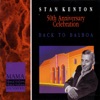
 Stan Kenton
Back to Balboa
Capitol Jazz 93094
Original recording 1957
|
|
Pianist Kenton leads one of his finest bands through a brassy and dramatic rendition of the song. The overall feeling is dark and foreboding, reminiscent of a film score rather than a love ballad.
|
 Sonny Rollins
Old Flames
1993 Milestone Records 9215
Original recording 1993
|
|
Heartbreaking poignancy comes from a saxophonist who had previously presented a relatively cheerful and mischievous face. Rollins wrings every tear out of his horn, stripping the song down and exposing its sad beauty.
|
 Darrell Grant
Twilight Stories
1998 32 Jazz 32079
|
|
Pianist Grant and his group uncover some glowing embers in “My Old Flame” and, by gently blowing some fresh air on them, they add new warmth to this enduring standard.
|
|
|
|