“As Time Goes By,” the song so closely associated with the film Casablanca, was written by Herman Hupfeld (sometimes spelled “Hupfield”) in 1931 for a Broadway musical entitled Everybody’s Welcome which opened on October 13, 1931, and ran for 139 performances. Frances Williams, a singer and actress who also appeared in a couple of Marx Brothers films, sang the song in the show and recorded it. The song charted twice that year: Rudy Vallee’s recording reached number 15 and Jacques Renard’s “sweet” band took it to number 13. Then the song was more or less forgotten.
|
|
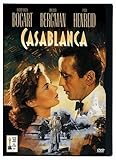
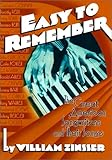
Casablanca, filmed in 1942 and starring Humphrey Bogart and Ingrid Bergman, was based on an unstaged play, Everybody Comes to Rick’s, by Murray Bernett and Joan Alison. “As Time Goes By” was part of the script of the original play. According to William Zinnser in Easy to Remember: The Great American Songwriters and Their Songs, “So fetching was Miss Williams’ record that a Cornell student named Murray Bernett fell in love with it...” When Bernett made a trip to Europe in 1938, he was stunned by the Nazi activities there. “On his way home,” continues Zinnser, “he happened to visit a bar in France that had an exotic clientele and a black man playing the piano. Back in New York, he wrote his impressions into a play set in French North Africa...which Warner Brothers would buy to make into Casablanca. The script specifies that when Ilsa first comes into Rick’s bar she asks the black piano player to play ‘As Times Goes By.’”
Max Steiner, who scored the movie, wanted to replace the song with a composition of his own, but Bergman was unavailable to reshoot the scenes in which the song appeared. Steiner “accepted his fate” and worked the song into the score as a “leitmotif.” So “As Time Goes By” remained in the film and was sung by Dooley Wilson who was unable to record it because of a musicians’ strike at the time. (Wilson was a drummer who also had sung with James Reese Europe’s band and led a band of his own.)
No one expected this haphazardly created film to be the success that it was. The script was being rewritten every day, and no one knew how the film would end. But everything seemed to click. The film appealed to the patriotism of the time, and the love story and the song were emotionally touching. Casablanca won three Academy Awards: Best Picture, Best Director (Michael Curtiz), Best Adapted Screenplay (Julius and Philip Epstein and Howard Koch). The film received five other nominations, including one for Steiner’s score. The film is near the top of almost everyone’s “best film” list, and in 1999 National Public Radio named “As Time Goes By” to its list of 100 most important American musical works of the 20th century.
As a result of the film’s success, Rudy Vallee’s 1931 recording of “As Time Goes By” was reissued and remained on Your Hit Parade for 16 weeks, taking over the number one slot for four weeks while Renard’s reissue reached number three. Ray Anthony and his band revived the song in 1952 with vocalist Tommy Mercer, and their recording charted for four weeks, reaching number ten.
After Bogart’s death in 1957 an art cinema near Harvard Yard began a Bogart film festival reviving interest in Casablanca and thus in “As Time Goes By.” “Since the mid-1970s,” says Zinnser, “Casablanca has been the most popular film shown on television; four of its lines have made it into Bartlett’s Familiar Quotations. But the glue holding it together is ‘As Time Goes By.’ ...It isn’t really a very good song; jazz musicians seldom play it except when someone asks for it. They don’t like it much more than Max Steiner did. Melodically it’s inert, lyrically it’s platitudinous. But emotionally it’s off the charts.”
Hupfeld, who led a quiet life in the house where he was born in Montclair, New Jersey, had a couple of minor hits to his credit (“Let’s Put Out The Lights (And Go To Sleep),” “Sing Something Simple,” and “When Yuba Plays the Rhumba on the Tuba”). Fortunately, he lived long enough to see the great success of “As Time Goes By.”
The seldom heard verse to his song speaks of the “apprehension” of the changing times in the early ‘30s and the need to balance “progress” with the simple facts of life, thus setting the stage for these memorable lines:
You must remember this
A kiss is just a kiss, a sigh is just a sigh.
The fundamental things apply
As time goes by.
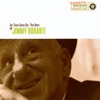
Dooley’s version of the song appears in Woody Allen’s 1972 film based on his 1969 Broadway show Play It Again, Sam, the title of which is a take-off on a Bergman line from Casablanca. In his film Allen receives dating advice from the ghost of Bogart whom only he can see and hear. The song has appeared in other movies, notably 1993’s Sleepless in Seattle, starring Tom Hanks and Meg Ryan, which featured comedian Jimmy Durante’s 1963 version of “As Time Goes By.”
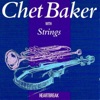
The song is inevitably in every musician’s recorded collection of songs from the movies. Jazz musicians who have covered the song include trumpeters Chet Baker and Freddie Hubbard, bassist Milt Hinton, saxophonist Dexter Gordon, pianists Erroll Garner, Bill Evans, and Eddie Higgins, vocalists Billie Holiday and Ella Fitzgerald, and, more recently, drummer Jeff “Tain” Watts, and pianists Jessica Williams and George Cables.
|