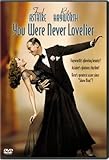
The 1942 film You Were Never Lovelier, starring Fred Astaire and Rita Hayworth, introduced the song “I’m Old Fashioned.” Astaire, an American hoofer stranded in Argentina with gambling debts, is mistaken by Hayworth as a mysterious lover who has been plying her with gifts. Her wealthy and disapproving father (Adolph Menjou) gives Astaire a job in his nightclub if he agrees to dissuade Hayworth. But everything he says about himself in an effort to diminish her affection for him appeals to her. Nan Wynn dubbed Hayworth’s voice as she sang “I’m Old Fashioned” to him in an effort to persuade him that they have much in common. She continues to sing as they begin an elegant, romantic, and memorable dance on a moonlit terrace to the orchestra of Xavier Cugat.
|
|
Composer Jerome Kern and lyricist Johnny Mercer wrote songs for the film which was nominated for three Oscars, including Best Original Song for another of their hits from the show, “Dearly Beloved.” Astaire was the first to record “I’m Old Fashioned” with the John Scott Trotter Orchestra, and their version rose to number 23 on the charts. Despite his monumental reputation as a dancer, Astaire was tremendously popular as a singer. At least three dozen of his recordings charted between 1929 and 1951, some for as long as 18 weeks. The great songwriters loved him because he delivered their songs exactly as intended.
|
|
Astaire’s recording of the song was used in the 1971 film A Safe Place. The song turned up in two Broadway revues: Jerome Kern Goes to Hollywood (1986) and Dream (1997). The famous dance by Astaire and Hayworth to “I’m Old Fashioned” was used by choreographer Jerome Robbins in 1983 as the title and centerpiece of his ballet for the New York City Ballet.
In The American Popular Ballad of the Golden Era, 1924-1950: A Study in Musical Design Allen Forte offers an extensive analysis of the song, calling it “one of Kern’s most eloquent and poetic musical statements. At the same time it is remarkable for its simplicity and directness, especially in the chorus.”
Alec Wilder offers this observation in his book American Popular Song: The Great Innovators, 1900-1950: “‘I’m Old Fashioned’ I find a particularly splendid song. The verse is as lovely as its lyric. Its chorus is comprised of comparatively few notes, none shorter than a quarter note, and its form is very satisfying and untypical: A-B-C-A1, the last section being extended to twelve measures.”
William Zinsser praises “I’m Old Fashioned” in Easy to Remember: The Great American Songwriters and Their Songs: “It’s one of his [Kern’s] finest songs, particularly pleasing because of the recurring use of the four-beat metrical motif that states the title. Every time we hear those four beats (‘this year’s fancies,’ ‘passing fancies,’ ‘I don’t mind it,’ ‘stay old-fashioned’), we’re reminded that we’re in the hands of a craftsman.
“The second half of the C section is a masterpiece of invention, moving, as it does, from A major in a series of imitations, up to a C-dominant-seventh chord as a preparation for a return to the principal statement. And it is a song of extremely narrow range, only a ninth, and attempts no climactic ending. In fact, the reverse.”
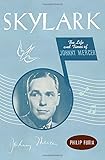
In his book Portrait of Johnny: the Life of John Herndon Mercer, Gene Lees quotes Mercer on his meeting with Kern: “‘But he did play me this song, and I had an idea for it. I brought it in, and he played it over. And he got to that note ‘stay old-fashioned’ and he got up and he hugged me. He called ‘Eva, Eva!--he called his wife. She ran downstairs and he kissed me on the cheek and he said, ‘Wait’ll you hear this lyric!’ Well, of course, you know, that makes you feel like a million dollars.”
Kern, of course, had good taste. Mercer’s lyric is imaginative and perfectly suited to both the melody and the situation. Astaire’s efforts to paint himself as a corn-fed, Midwestern type to the wealthy, sophisticated Hayworth only inspire her to insist that she, too, is down-to-earth and loves old fashioned things like “the sound of rain, upon a window pane, the starry song that April sings.” She further insists that “This year’s fancies, are passing fancies” and urges him “to stay old fashioned with me.”
Johnny Mercer recorded “I’m Old Fashioned” several times; Ella Fitzgerald sang it in her Kern tribute, John Coltrane recorded it on Blue Train, Joanne Brackeen played it as a piano solo at her Maybeck recital, and guitarists Bucky and John Pizzarelli recorded it as a duo. Bassist Richard Davis recorded it in 2000 as did guitarist Martin Taylor; vocalist Cassandra Wilson gave the tune an upbeat treatment in her 2002 release; saxophonist Bennie Wallace recorded in 2004, and pianist Ahmad Jamal, in 2005; pianist Barry Harris’ title cut album was reissued in 2004; and pianist/bandleader Bob Florence cleverly arranged it for big band in 2007.
|