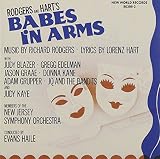
The 1937 Broadway musical Babes in Arms, with music by rodgers and Hart, ran for 289 performances and produced several hit songs: “My Funny Valentine,” “Johnny One-Note,” I Wish I Were in Love Again,” “The Lady Is a Tramp,” “Where or When,” and the title song. The musical revolved around a group of teenagers who put on a show in an effort to avoid being sent to a work camp. “Where or When” was introduced in the show by young Mitzi Green and Ray Heatherton. The cast also included future stars Dan Dailey and Alfred Drake who sang the title song.
|
|
The orchestra of Hal Kemp with Skinnay Ennis on vocals took “Where or When” to the charts in 1937 for 16 weeks where it spent one week as number one. The flip side of the recording was another song from the show, “Johnny One-Note,” which charted for three weeks. In 1943 Guy Lombardo and His Royal Canadians also had a hit with “Where or When.” Your Hit Parade featured the song eight times.
|
|
Oddly, for the 1939 movie of the same name which starred Mickey Rooney and Judy Garland most of the Rodgers and Hart score was cut except for “Babes in Arms,” “Where or When” (which was not well featured), and “The Lady Is a Tramp” (heard only as an instrumental). “Where or When” is sung by Betty Jaynes and Douglas McPhail in a rehearsal sequence in the film, and Judy Garland is later cut short in her performance of the tune. New songs were written for the film by Arthur Freed, Nacio Herb Brown, and others, and the score received an Oscar nomination.
Long before socio-political topics became de rigeur on Broadway, Rodgers and Hart were tackling such issues in their musicals. The script for the original Babes in Arms appeared to be lost but was revived in 1959 by drama critic George Oppenheimer under the supervision of Rodgers. This is the version which is now presented in revivals. In the show the wealthy Southerner who agrees to back the kids’ production will do so only if the black dancers (played on Broadway by the incredible Nicholas Brothers) do not appear in it. The teenagers are outraged, but the show goes on; however, not without a happy ending.
Alec Wilder, discussing “Where of When” in his book American Popular Song: The Great Innovators, 1900-1950, says, “Because of its unprecedented octave and a fourth climb, step-wise, which constitutes the closing statement of the song, it must be considered a dramatic song.” Wilder finds this device melodramatic and “the plethora of repeated notes” monotonous.
Hart’s lyrics describe the frustration of deja vu in “Where or When”:
It seems we stood and talked like this before,
we looked at each other in the same way then,
but I can’t remember where or when.
In his book The Poets of Tin Pan Alley: A History of America’s Great Lyricists Philip Furia points out that the monotony of Rodgers’ repeated notes heightens the torment and that “Hart’s rhymes have the teasing simplicity of deja vu: ‘then’ and ‘when’ echoing under ‘happening again’....”
Richard Rodgers in his autobiography Musical Stages says that he and Hart received mail from college psychology professors who used the song to illustrate lectures on the psychic phenomenon.
Lena Horne sang “Where or When” (as well as “The Lady Is a Tramp”) in the Rodgers and Hart biopic Words and Music. Frank Sinatra used the song as an album title, Erroll Garner recorded a stunning version on Concert by the Sea, Dion and the Belmonts had a hit with it in 1960, Harry Connick, Jr. sang it on the soundtrack of When Harry Met Sally, and pop star Rod Stewart included it in his album of standards. It remains a favorite of contemporary artists such as trumpeter Wynton Marsalis, saxophonists Anton Schwartz and Eric Alexander, pianists Lynne Arriale and Stefan Scaggiari, vocalists Jay Clayton, Norma Winstone, and Giacomo Gates, and guitarist Ron Eschete.
|