|
|
|
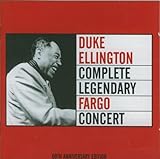
| “[Ben Webster] did an impromptu four-minute improvisation on the number ... [which] became Webster’s own favorite recording. ” |
|
 |
|
- Chris Tyle
|
|
| |
On October 31, 1927, Hoagy Carmichael and His Pals recorded “Stardust” at the Gennett Records studio in Richmond, Indiana. Hoagy’s “pals,” Emil Seidel and His Orchestra, agreed to record the medium-tempo instrumental in between their Sunday evening and Monday matinee performances in Indianapolis, seventy miles away.
In 1928 Carmichael again recorded “Stardust,” this time with lyrics he had written, but Gennett rejected it because the instrumental had sold so poorly. The following year, at Mills Music, Mitchell Parish was asked to set lyrics to coworker Carmichael’s song. The result was the 1929 publication date of “Star Dust” with the music and lyrics we know today. The Mills publication changed the title slightly to “Star Dust” from “Stardust” as it was originally spelled.
|
| |
| |
|
| |
|
|
| |
| |
|
| |
|
Mills Music was owned and operated by brothers Irving and Jack Mills. Irving Mills was a songwriter and singer but is probably best remembered in his role as publisher and band manager, in particular with the Duke Ellington Orchestra. In the latter half of the 1920’s Irving Mills recruited musicians for recording sessions using the names The Whoopee Makers and then Irving Mills and His Hotsy Totsy Gang. Band members would change almost month-to-month, but at some point these groups included top names such as Benny Goodman, Bix Beiderbecke, Jack Teagarden, Tommy Dorsey, Jimmy Dorsey, and Hoagy Carmichael.
|
| |
| |
|
| |
|
Irving Mills and His Hotsy Totsy Gang recorded “Star Dust” on September 20, 1929, on the Brunswick label, and the song rose to number 20 on the 1930 pop charts. Shortly after the Mills recording, Isham Jones and His Orchestra recorded “Star Dust” as a romantic ballad, and their recording became a top-selling, number one hit.
|
| |
| |
|
| |
|
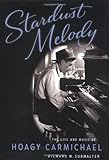
There are many accounts of how “Star Dust” came to be written. Carmichael tells his version in autobiographies The Stardust Road (1945) and Sometime I Wonder (1965); Will Friedwald devotes a 36-page chapter to the song in his book Stardust Melodies (2002); and Richard Sudhalter discusses the origin of the song in his Carmichael biography Stardust Melody: The Life and Music of Hoagy Carmichael (2002). According to the songwriter, inspiration struck while visiting his old university campus. Sitting on a wall reminiscing about the town, his college days, and past romances, he looked up at the starlit sky and whistled “Star Dust.” Sudhalter’s biography contends that the melody may have begun with fragments, evolving over months and maybe years, but Carmichael preferred to perpetuate a myth that sweet songs are conceived in romantic settings.
“Star Dust” is arguably the most recorded pop tune in history and, as such, a top jazz standard. The song has appeared on the recording charts with over fifteen artists. Billboard Magazine’s 1955 poll of leading disk jockeys recognized “Star Dust” four times as an all-time, popular song record by:
Many other recordings of “Star Dust” made the recording charts over the years:
- Irving Mills and His Hotsy Totsy Gang (1930, Hoagy Carmichael, Piano, #20)
- Isham Jones and His Orchestra (1931, #1)
- Bing Crosby (1931, #5)
- Louis Armstrong (1931, Louis Armstrong, trumpet and vocal, #16)
- Wayne King and His Orchestra (1931, #17)
- Lee Sims (1931, #20)
- Jimmie Lunceford and His Orchestra (Henry Wells, vocal) (1935, #10)
- Benny Goodman and His Orchestra (1936, #2)
- Tommy Dorsey and His Orchestra (1936, Edythe Wright, vocal, #8) (flip side of Benny Goodman’s Victor recording)
- Sammy Kaye and His Orchestra (1939, #16)
- Artie Shaw and His Orchestra (1941, #2)
- Tommy Dorsey and His Orchestra (Frank Sinatra and The Pied Pipers, vocals) (1941, #7)
- Glenn Miller and His Orchestra (1941, #20)
- Baron Elliott and His Stardust Melodies Orchestra (1943, Stardust Trio, vocals, #18)
- Tommy Dorsey and His Orchestra (1943, #23) (reissue of the 1941 recording)
- Bill Ward and His Dominos (1957, #12)
- Nino Tempo and April Stevens (1964, #32)
|
|
| |
|
| |
|
(Chart information from the latter two entries is from The Billboard Book of Top 40 Hits
|
|
|
|
More information on this tune... |
|
See the Reading and Research page for this tune for additional references. |
|
- Jeremy Wilson
|
|
| This section suggests definitive or otherwise significant recordings that will help jazz students get acquainted with
“Star Dust.” These recordings have been selected from the Jazz History and
CD Recommendations sections.
|
The version of “Stardust” that has had perhaps the greatest impact on the jazz world is Louis Armstrong’s from 1931 ( Ken Burns JAZZ Collection: Louis Armstrong). His trumpet and vocals are both heard at full maturity on this performance which ranks as one of the great early ballad performances in jazz history. Hoagy Carmichael’s own versions are also important for obvious reasons, with his mid-1940s small combo recording ( Ole Buttermilk Sky) serving as a particularly good starting point.
Noah Baerman - Jazz Pianist and Educator
|
The song’s appeal to both jazz performers and listeners defies analysis. Its A-B-A-C structure is unconventional for a pop song*, and the melody is unusual in that it takes wide swings as a matter of course, not just at particular points of expression. Oscar Hammerstein II comments in the preface of his book Lyrics that “Star Dust” “rambles and roams like a truant schoolboy in a meadow. Its structure is loose, its pattern complex. Yet it has attained the kind of long-lived popularity that few songs can claim. What has it got? I’m not certain. I know only that it is beautiful and I like to hear it.”
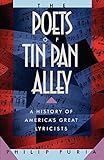
Clearly Mitchell Parish’s lyrics are integral to the success of the song, creating an indelible mood. Originally Carmichael’s composition was played at a medium tempo suitable for dancing, but vocalists soon demanded that the tempo be slowed down to a pace in keeping with the dreamy lyrics. Parish’s phrases are strung together in a way that transforms his lush imagery from overly romantic to compelling, all the while supporting the flow of the tune. In The Poets of Tin Pan Alley: A History of America’s Great Lyricists, Philip Furia comments, “Parish’s skill is manifest in the way he created a long, but conversational line that followed the contour of the melody, pausing with the music, but then driving forward syntactically.” Even when listening to an instrumental performance of “Star Dust” one cannot help but recall, if not the words, the feelings the lyrics evoke. -JW
* A visitor comments that the A-B-A-C form is not that unusual:
Your analysis of Stardust says that ABAC form is “unusual for a pop song”. My analysis of over 230 jazz standards shows that approximately 50% are AABA form and 30% are ABAC. Since most of these were pop songs in their day, this shows ABAC is not an unusual form, especially in 1927 when this song was written.
Examples include: Tea for Two, The Boy Next Door, All of You, Autumn in NY, Beautiful Love, But Beautiful ...
John Elliott, pianist and jazz educator
www.dropback.co.uk
|
Musical analysis of
“Star Dust”
|
| Original
Key |
C major |
| Form |
A – B – A
– C |
| Tonality |
Major throughout |
| Movement |
Highly arpeggiated
in both directions; some chromatic embellishment |
|
Comments
(assumed
background)
|
| Despite being “all over the place” (over
the range of a tenth), this tune stays firmly
in a single key throughout. Musicians have
commented on its resemblance to the improvisational
style of cornetist Bix Beiderbecke (who
was a good friend of composer Carmichael).
The opening harmonic sequence, IV – iv –
I – iii – VI7 – ii – VI7(+5) – ii – V7 -
I bears strong resemblance to the second
half of “After You’ve Gone,” except for the insertion
of the iii chord and the extended V7 (actually
turning into a V7(+5) before resolving back
to I) in place of the second iv chord. The
“B” section is a long II7 – V7exchange,
with the II7 becoming minor before resolving
to the last V7 – I, event though technically,
the I chord at that point – a I7(+5) – is
really a V7 of the upcoming IV (F major
in the original).
“C” contains a bit of
a surprise; starting out with IV – iv, it
returns to the tonic and its relative minor
(I –vi, or C major and A minor in the original).
Instead of going to the logical ii7 (or
even III7), however, Carmichael goes to
a VII7 (Am – B7). This resolves to the III7
(E7), as might be expected, but then goes
to ii7 before the logical resolution of
VI7 (A7). The VI7 resolves normally to the
final ii7 – V7– I progression. Why Carmichael
took the detours is hard to say; melodically,
an E7 in measure 4 of section “C” would
have worked just as well and made more sense
from a tonal standpoint. Such deceptive
resolutions were prevalent in late Romanticism
and Impressionist music, both of which of
were strong influences on Bix Beiderbecke’s
music. |
|
K. J. McElrath - Musicologist for JazzStandards.com |
|
On November 7, 1940, a milestone in jazz recording
occurred.
Duke Ellington and His Orchestra, on a US tour,
performed in Fargo, North Dakota. Two local Ellington
fans had arranged to record the band live, a rare
occurrence in those days of primitive recording
equipment. During the course of the evening, the
Ellington band swung through many of their great
arrangements. At one point, a patron requested “Stardust,”
a tune for which Ellington didn’t have a special
arrangement. Tenor saxophonist Ben Webster, in a
performance remarkably similar to Coleman Hawkins’
“Body and Soul” of the previous year, did an impromptu
four-minute improvisation on the number. His version,
which wasn’t commercially released until the 1970s,
became Webster’s own favorite recording.
Chris Tyle - Jazz Musician and Historian
|
Additional information for "Star Dust" may be found in:
|
|
|
 George T. Simon
Big Bands Songbook
Barnes & Noble
Paperback
(4 pages including the following types of information: history, performers, song writer discussion and sheet music.)
|
|
|
|
|
 Thomas S. Hischak
The Tin Pan Alley Song Encyclopedia
Greenwood Press
Hardcover: 552 pages
(1 paragraph including the following types of information: film productions, history and performers.)
|
|
|
|
|
 Alan Lewens
Popular Song: Soundtrack of the Century
Watson-Guptill Publications
Paperback: 192 pages
(1 page including the following types of information: history, performers, style discussion and song writer discussion.)
|
|
|
|
|
 Will Friedwald
Stardust Melodies
Pantheon; 1st edition
Hardcover: 416 pages
(34 pages including the following types of information: history, lyric analysis, music analysis, performers, recordings and song writer discussion.)
|
|
|
|
|
 Robert Gottlieb, Robert Kimball
Reading Lyrics
Pantheon
Hardcover: 736 pages
(Includes the following types of information: song lyrics.)
|
|
|
|
|
“Star Dust” was included in these films:
- Star Dust (1940)
- Hi Buddy (1943)
- Stardust Memories (1980,
Louis Armstrong and His Orchestra)
- Goodfellas (1990, Billy Ward
and His Dominos)
- Sleepless in Seattle (1993,
Nat “King” Cole)
- Casino (1995)
And on the small screen:
- The Flintstones (1960, Fred,
Barney, and Hoagy Carmichael)
|
| This section shows the jazz standards written by the same writing team. |
|
|
|
|
Comment Policy
- Your comments are welcome, including why you like
this tune, any musical challenges it presents, or additional background information.
- Jazz musicians, fans, and students of all ages use this website as an educational resource.
As such, off-topic, off-color, unduly negative, and patently promotional comments will be removed.
- Once submitted, all comments become property of JazzStandards.com.
By posting, you give JazzStandards.com permission to republish or otherwise distribute your comments in any format or other medium.
JazzStandards.com reserves the right to edit or remove any comments at its sole discretion.
|
|
| Click on any CD for more details at Amazon.com |
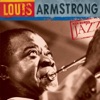
 Louis Armstrong
Ken Burns Jazz Collection
2000 Sony 61440
Original recording 1931
|
|
This is one of the classic performances displaying Armstrong’s emergence as a compelling frontman in a large ensemble environment.
|
 Lionel Hampton
Hamp: The Legendary Decca Recordings
1996 GRP 652
Original recording 1947
|
|
Hamp’s epic live version of “Stardust” distributes solos among the all-star band, which includes such jazz giants as trumpeter Charlie Shavers, alto saxophonist Willie Smith, bassist Slam Stewart and guitarist Barney Kessel.
|
 Clark Terry
Serenade to a Bus Seat
1993 Original Jazz Classics 66
Original recording 1957
|
|
Terry shows off his mastery of bittersweet ballads on this performance, which also features an energetic turn from tenor saxophonist Johnny Griffin.
|
 John Coltrane
Stardust Session
Prestige 24056
Original recording 1958
|
|
We get to hear Coltrane’s contemplative side here with the understated accompaniment of Red Garland, Paul Chambers and Jimmy Cobb.
|
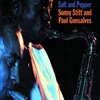
 Sonny Stitt and Paul Gonsalves
Salt and Pepper
1997 GRP 210
Original recording 1963
|
|
This features wonderfully sensitive interplay between Stitt’s alto and Gonsalves’ tenor, and each saxophonist shines on his own as well.
|
 Ron Carter
Stardust
2002 Blue Note 37813
|
|
Bassist Carter plays a touching version of “Stardust” accompanied only by the piano of Sir Roland Hanna.
|
|
 Ernestine Anderson
Ernestine Anderson
1992, Polygram 14076
Original recording, 1958
|
|
In one of the singer’s earliest recordings she plays it straight with a beautiful ballad version.
|
 Jon Hendricks & Friends
Freddie Freeloader
1993, Denon 76302
Original recording, 1990
|
|
Hendricks wrote lyrics to Louis Armstrong’s version of “Star Dust” and sings them here with Judith Hendricks and the Vocalstra in a unique take on the classic.
|
|
 Hoagy Carmichael
Ole Buttermilk Sky
1998 Collectors Choice 64
|
|
The master plays and sings the definitive version of “Star Dust”’ on this compilation that shows Carmichael to be arguably the finest singer-songwriter of all time.
|
 Dave Brubeck Quartet
Jazz at Oberlin
1991 Original Jazz Classics 46
Original recording, 1953
|
|
This version, captured live at Oberlin College in Ohio, hints at the new directions Brubeck would be taking jazz with Time Out.
|
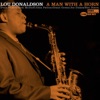
 Lou Donaldson
A Man with a Horn
1999 Blue Note 21436
Original recording 1961
|
|
This album features a laid-back arrangement from the bluesy, hard bop saxophonist. The under-appreciated Donaldson trades some tasty solos with guitarist Grant Green.
|
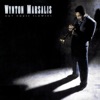
 Wynton Marsalis
Hot House Flowers
1990, Sony 39530
Original recording, 1984, Columbia
|
|
The song introduced this early Marsalis album and proved without a doubt that the trumpeter had something to say. “Star Dust” is the crown jewel of this excellent album.
|
|
|
|