|
|
|
| “Groovin’ High” is a “bebop” head loosely based on the chord progression of “Whispering.” |
|
 |
|
- K. J. McElrath
|
|
| |
Dizzy Gillespie took a sextet into the studio on February 9, 1945, and recorded two new compositions, “Groovin’ High,” a medium tempo tune based on the chord changes of “Whispering” (written in 1920), and “Blue ‘N’ Boogie.” In his book Dizzy: The Life and Times of John Birks Gillespie, Donald L. Maggin says, “Dizzy created a complex arrangement for ‘Groovin’ High,’ which became one of his most enduring hits; it encompasses a six-bar introduction, three key changes, transition passages between solos, and a half-speed coda as it demonstrates his skill in fashioning interesting textures using only six instruments.”
|
| |
| |
|
| |
|
Gary Giddins in his book Visions of Jazz: The First Century claims, “Dizzy once said he might have gotten the idea for ‘Groovin’s High’ from a childhood matinee serial (starring Yakima Canutt, he thought) that had ‘Whispering’ as the theme song--a poetic and perhaps calculated juxtaposition of eras and cultures that agreeably disguises the scope of his sorcery.”
In his book Inside Jazz Leonard Feather says, “The last four trumpet measures of ‘Groovin’ High’ later provided Tadd Dameron with part of the theme for a beautiful ballad recorded by Sarah Vaughan, ‘If You Could See Me Now.’”
The following March of 1945 Dizzy recorded the tune again, this time fronting a quintet featuring Charlie Parker. According to Maggin, “The reworking of ‘Groovin’ High’ makes one important change in the complex arrangement. Dizzy curtailed his chorus to allow [guitarist Remo] Palmieri a short improvisation. Again, Dizzy and Bird managed a magical unison theme statement, and each performed intricate melodic improvisations over the unvarying swing rhythm.”
In December, 1945, Dizzy recorded the tune again at Billy Berg’s club in Los Angeles with Stan Levey, Ray Brown, Charlie Parker, and Al Haig (Milt Jackson was on the gig but laid out for this tune). “Freed from the three-minute constraints of the 78 rpm record, the musicians stretched out on tracks that ran for roughly five minutes. They were all in top form as they provided a fitting climax to a year of stellar bebop recordings,” says Maggin.
Dizzy and Bird, backed by John Lewis, Al McKibbon, and Joe Harris, performed “Groovin’ High” on September 29, 1947, to an appreciative audience at Carnegie Hall. By the ‘50s Gillespie was touring the world and was received by enthusiastic audiences in Paris (1952) and Brazil (1956). In 1982 he and Stan Getz performed “Groovin’ High” at the White House. |
|
|
|
| This section suggests definitive or otherwise significant recordings that will help jazz students get acquainted with
“Groovin' High.” These recordings have been selected from the Jazz History and
CD Recommendations sections.
|
Though pre-dated by a few weeks by another recording featuring Dexter Gordon, Dizzy Gillespie’s brilliant February 28, 1945 recording featuring Charlie Parker (Ken Burns Jazz) is widely acknowledged as the definitive version of “Groovin’ High.” Gillespie and Parker both recorded the song often in the few years that followed, and their 1945 Town Hall recording (Town Hall, New York City, June 22, 1945) is a good document of what they were doing with it when given more room to stretch out in their solos. Many bop-influenced musicians have performed the song since, and Lou Donaldson’s 1957 recording (Lou Takes Off) offers a particularly strong example of how the language had developed into the 1950s.
Noah Baerman - Jazz Pianist and Educator
|
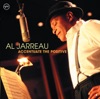
Vocalist and ace scatter Al Jarreau, who left jazz for the world of pop, R&B, and smooth jazz after his fine 1977 recording Look to the Rainbow, returned in 2004 with Accentuate the Positive, a collection of jazz standards which includes “Groovin’ High” for which he has written clever lyrics. Not only does he deal deftly with Dizzy’s opening staccato phrases, but he refers to the lyrics of “Whispering,” the tune which provided the chord changes for Gillespie’s composition:
Be silent
And listen
The summer night has got something to say
Honey be silent
And listen
A little whisper like a preacher would pray.
Jarreau ends the song with excerpts of the original lyrics from “Whispering” which, not surprisingly, fit “Groovin’ High” perfectly:
Whispering while you cuddle near me
Whispering so no one can hear me.
- Sandra Burlingame
|
Musical analysis of “Groovin’ High”
|
|
Original Key
|
Eb major
|
|
Form
|
A - B - A - C
|
|
Tonality
|
Major throughout
|
|
Movement
|
Beginning with a descending major third, the melodic line arpeggiates wildly in both directions; several instances of chromatic embellishing tones
|
|
Comments (assumed background)
|
|
This is a “bebop” head loosely based on the chord progression of “Whispering.”It is worthwhile to compare the two, as such a comparison illustrates the evolution of chord substitutions as applied to existing melodies, especially in its early stages. Most noteworthy is Gillespie’s use of the “ii7-V” cadence. For instance, whereas his source tune went from tonic to the chord one-half step lower (in this case, Eb to D7), Gillespie precedes the subsequent chord with a minor seventh a tri-tone away (Eb - Am7 - D7), creating a “ii7 - V7/iii” cadence that resolves deceptively back to the tonic. He does this again in mm.7-8; whereas the original tune went from I - V7(#7)/II (Eb- C7(#5)), Gillespie uses a minor 7th chord (Gm7). This type of substitution has become quite common among jazz players of the last half-century.
|
|
K. J. McElrath - Musicologist for JazzStandards.com
|
|
During World War II and shortly thereafter,
the Armed Forces Radio Department recorded
a number of live performances by jazz greats.
One from late 1945 featured Dizzy Gillespie
and Charlie Parker’s group at the time of
their engagement at Billy Berg’s in Los
Angeles. The six-minute performance easily
bests the issued recording made earlier
that year. Two years later, another stunning
performance by Parker and Gillespie was
recorded at their Carnegie Hall appearance.
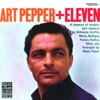
Alto saxophonist Art Pepper, like many
alto players of the late ‘40s and ‘50s,
fell under the spell of Parker, but Art’s
playing also had touches of Benny Carter
and tenor saxophonist Lester Young (one
Parker’s influences). Pepper’s 1959 recording
of “Groovin’ High,” backed by a group of
top-flight Los Angeles musicians with arrangements
by Marty Paich, is a delight.
Chris Tyle - Jazz Musician and Historian
 Art Pepper
Art Pepper + Eleven
Original Jazz Classics 341
Original recording, 1959, Contemporary
|
|
|
|
|
Additional information for "Groovin' High" may be found in:
|
|
|
| This section shows the jazz standards written by the same writing team. |
|
|
|
|
Comment Policy
- Your comments are welcome, including why you like
this tune, any musical challenges it presents, or additional background information.
- Jazz musicians, fans, and students of all ages use this website as an educational resource.
As such, off-topic, off-color, unduly negative, and patently promotional comments will be removed.
- Once submitted, all comments become property of JazzStandards.com.
By posting, you give JazzStandards.com permission to republish or otherwise distribute your comments in any format or other medium.
JazzStandards.com reserves the right to edit or remove any comments at its sole discretion.
|
|
| Click on any CD for more details at Amazon.com |
 Dizzy Gillespie
Ken Burns JAZZ Collection: Dizzy Gillespie
Polygram Records
Original Recording 1945
|
|
This is the best-known version of “Groovin’ High” and it still sounds remarkably fresh. Gillespie takes it at a swinging medium tempo and plays a wonderful, dexterous solo, as do saxophone giant Charlie Parker and bassist Slam Stewart.
|
 Dizzy Gillespie;Charlie Parker
Town Hall, New York City, June 22, 1945
Uptown Jazz
Original Recording 1945
|
|
Recorded only months after the tune’s original studio recordings, this one documents a live performance and thus allows us to hear both Dizzy Gillespie and Charlie Parker stretch out a bit on their solos. The band is rounded out by pianist Al Haig, who takes a nice solo of his own, bassist Curley Russell and drummer Max Roach.
|
 Carter, Baranco, Mundy, Wilson
Groovin' High in Los Angeles: 1946 Vol 1
Allegro Corporation
Original Recording 1946
|
|
This recording is both the first “cover version” of the song and first big band version. Gerald Wilson’s arrangement is brash and clever, fully integrating the still-new bop language. Soloists here include trumpeter Hobart Dotson, saxophonist Eddie (“Lockjaw”) Davis and pianist Jimmy Bunn.
|
 Hampton Hawes
All Night Session 1
Ojc
Original Recording 1956
|
|
Hawes and his quartet take “Groovin’ High” at a brisk tempo. He and guitarist Jim Hall both contribute hard-swinging and extremely fluid solos.
|
 Lou Donaldson
Lou Takes Off
Blue Note Records
Original Recording 1957
|
|
The development of bebop can be heard well here on alto saxophonist (and Charlie Parker disciple) Donaldson’s hard-swinging performance. There are great, flowing solos by Donaldson, Donald Byrd on trumpet, Curtis Fuller on trombone and Sonny Clark on piano, while Jamil Nasser and Arthur Taylor keep things propulsive in the rhythm section.
|
 Cannonball Adderley
Things Are Getting Better
Ojc
Original Recording 1958
|
|
Saxophonist Cannonball Adderley and vibraphonist Milt Jackson keep things hard-swinging but relaxed on this authoritative performance. Wynton Kelly also contributes a solo, while Percy Heath and Art Blakey shine in supporting roles.
|
 Hank Jones
Groovin High
Pony Canyon Japan
Original Recording 1978
|
|
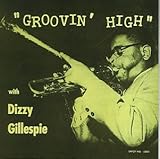
Piano giant Jones interprets “Groovin’ High” in an unorthodox trio with his brother Thad on cornet and Mickey Roker on drums. Between the hard-swinging groove, Roker’s infectious brushes and Hank’s expert bop-inflected comping, the bass is not missed at all, and both of the Joneses solo brilliantly.
|
|
 Al Jarreau
Accentuate the Positive
2004 GRP Records 163402
|
|
Singer Jarreau presents the song as a vocalese melting pot, his rich tenor taking the place of Gillespie’s horn as he scats and invents off the cuff.
|
 Booker Ervin
Groovin' High
1996 Original Jazz Classics 919
Original recording 1964
|
|
Drummer Alan Dawson and bassist Richard Davis keep the tempo high as saxophonist Ervin and trumpeter Carmell Jones trade hot bop licks.
|
 Bobby Timmons Trio
Easy Does It
1992 Original Jazz Classics 722
Original recording 1961
|
|
Pianist Timmons’ fingers simply fly across the keys as the rhythm section maintains a fast and furious bop tempo in this wonderful reading of the tune.
|
 Toots Thielemans
East Coast West Coast
1994 Private Music 82120
|
|
The harmonica master joins horn players Joshua Redman and Terence Blanchard for some unison lines before devising a creative solo. The fine rhythm section features Lyle Mays (piano), Christian McBride (bass), and Troy Davis (drums).
|
|
|
|