|
|
|
| “...Ellington was a visionary whose music wasn’t fitting into the preconceived notions of what was considered to be jazz.” |
|
 |
|
- Chris Tyle
|
|
| |
“Come Sunday” was first introduced by Duke Ellington and His Orchestra at their first Carnegie Hall concert on January 23, 1943. Ellington recorded the piece for RCA Victor the following year.
|
| |
| |
|
| |
|
In 1942 Ellington and His Orchestra were engaged for a special performance at Carnegie Hall, and for the event Ellington composed an extended piece entitled “Black, Brown and Beige,” each color denoting a section of the piece corresponding to a period of time in the history of African-Americans in America. Ellington described it as “a tone parallel....” “Come Sunday” is what is now known as the 32-bar, AABA-form song (which Ellington wrote for alto saxophonist Johnny Hodges), but originally it was part of a 12-minute portion of the first section, “Black.”
Ellington had composed extended pieces prior to “Black, Brown and Beige.” His first, from 1931, was entitled “Creole Rhapsody.” Then in 1934 his “Symphony in Black” was made into a short film feature. In 1935 the piece “Reminiscing in Tempo” (in four parts) took up two 78 rpm records (a radical concept for a jazz group at the time), and this was followed by the two-part “Diminuendo in Blue” and “Crescendo in Blue” from 1937. It was clear that Ellington envisaged his music to go beyond the standard 32-bar, pop-song convention of the day, an idea that was contrary to the way many, including music critics, viewed the band. In fact, Ellington’s manager of 12 years, Irving Mills, resigned following the issuance of the recordings of “Reminiscing in Tempo.”
Obviously, Ellington was a visionary whose music wasn’t fitting into the preconceived notions of what was considered to be jazz. During the 1930s and ‘40s, Ellington’s compositions were tending to go in radically different directions than the music by other big bands of the time. Also, for years his compositions had been tailored to the individual sounds of his band members, and he was the first of relatively few bandleaders to utilize this approach.
The critics generally panned “Black, Brown and Beige.” The jazz critics felt Ellington was somehow deserting jazz for “serious music” (the term at the time for orchestral or “classical” music), and the “serious music” critics felt it wasn’t up to the great classical compositions. Caught in the cross-fire, Ellington was clearly upset and soon after began to utilize the term “beyond category” for his music rather than using the word jazz. It’s clear in retrospect that neither critical camp understood what Duke was attempting, and he was so disturbed by the turns of events that it would be several years before he would attempt anything similar. Thankfully, however, he continued to compose extended works and eventually gained the critical respect he so deserved.
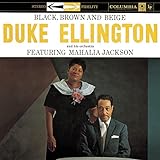
In 1944 Ellington and the orchestra commercially recorded excerpts from “Black, Brown and Beige” (including “Come Sunday”), but it wasn’t until 1958 that he would revise the piece and record it in its entirety for Columbia Records. In the 1970s, the 1943 live performance was issued for the first time on LP.
|
|
|
|
| This section suggests definitive or otherwise significant recordings that will help jazz students get acquainted with
“Come Sunday.” These recordings have been selected from the Jazz History and
CD Recommendations sections.
|
Because “Come Sunday” was initially nestled within the “Black Brown and Beige” suite, there are many great early recordings of the song in that context. Ellington first recorded the song on its own in 1944 (The Complete RCA-Victor Mid-Forties Recordings), a performance that features Ray Nance and Johnny Hodges. Nance also appears on what many consider to be the definitive version of the song, a 1958 recording (Black, Brown and Beige) with the vocals of Mahalia Jackson. In a small-group, instrumental setting, Ben Webster’s 1963 version with Joe Zawinul (Soulmates) is particularly strong.
Noah Baerman - Jazz Pianist and Educator
|
|
Musical analysis of “Come Sunday”
|
|
Original Key
|
Bb major; temporary shift to G minor during “B”
|
|
Form
|
A - A - B - A
|
|
Tonality
|
Primarily major
|
|
Movement
|
Gradually upward via steps and skips, rising to the highest note of “A,” followed by a descending pentatonic scale and a lower embellishing tone before arriving at the tonic. “B” starts in the high range of the melody, descending by a series of scale patterns.
|
|
Comments (assumed background)
|
|
Slow moving both rhythmically and harmonically with sustained notes at the end of each phrase, this one requires good breath control. Harmonic progression is somewhat unusual and strongly suggestive of the works of Billy Strayhorn in its use of extended harmonies - especially the #11 in measure 2 of “A” and frequent use of the 9th and 13th in the melodic line. One may wish to compare the harmonic structures in this tune to those of “Chelsea Bridge” and “Upper Manhattan Medical Group.”
|
|
K. J. McElrath - Musicologist for JazzStandards.comle style="width: 100%" cellpadding="10" border="1">
|
|
Musical analysis of “Come Sunday”
|
|
Original Key
|
Bb major; temporary shift to G minor during “B”
|
|
Form
|
A - A - B - A
|
|
Tonality
|
Primarily major
|
|
Movement
|
Gradually upward via steps and skips, rising to the highest note of “A,” followed by a descending pentatonic scale and a lower embellishing tone before arriving at the tonic. “B” starts in the high range of the melody, descending by a series of scale patterns.
|
|
Comments (assumed background)
|
|
Slow moving both rhythmically and harmonically with sustained notes at the end of each phrase, this one requires good breath control. Harmonic progression is somewhat unusual and strongly suggestive of the works of Billy Strayhorn in its use of extended harmonies - especially the #11 in measure 2 of “A” and frequent use of the 9th and 13th in the melodic line. One may wish to compare the harmonic structures in this tune to those of “Chelsea Bridge” and “Upper Manhattan Medical Group.”
|
|
K. J. McElrath - Musicologist for JazzStandards.com
|
|
Although it was a small part of the original
11-minute section of “Black,” from Duke
Ellington’s 1943 extended piece “Black,
Brown and Beige,” what is now referred to
as “Come Sunday” is the 32-bar section of
the piece written specifically for the distinctive
sound of alto saxophonist
Johnny Hodges. In addition to several
versions he recorded with Duke Ellington,
Hodges’ beautiful exposition of the tune
from 1952 captures him during a period when
he was fronting his own group, on a hiatus
from Duke’s band.
In 1958 Ellington recorded a revised
version of “Black, Brown and Beige” for
Columbia Records. A highpoint of the recording
is the vocal version of “Come Sunday,” sung
by the majestic gospel singer Mahalia Jackson.
A CD reissue of the 1958 session released
in 1996 includes several alternate takes
not on the original and an interesting a
cappella rendition by Jackson.
Chris Tyle - Jazz Musician and Historian
|
Additional information for "Come Sunday" may be found in:
|
|
|
 James Lincoln Collier
Duke Ellington
Oxford University Press, USA
Hardcover: 352 pages
(1 paragraph including the following types of information: music analysis.)
|
|
|
|
|
 Gary Giddins
Visions of Jazz: The First Century
Oxford University Press; New Ed edition
Paperback: 704 pages
(2 paragraphs including the following types of information: history.)
|
|
|
|
|
| This section shows the jazz standards written by the same writing team. |
|
|
|
|
Comment Policy
- Your comments are welcome, including why you like
this tune, any musical challenges it presents, or additional background information.
- Jazz musicians, fans, and students of all ages use this website as an educational resource.
As such, off-topic, off-color, unduly negative, and patently promotional comments will be removed.
- Once submitted, all comments become property of JazzStandards.com.
By posting, you give JazzStandards.com permission to republish or otherwise distribute your comments in any format or other medium.
JazzStandards.com reserves the right to edit or remove any comments at its sole discretion.
|
|
| Click on any CD for more details at Amazon.com |
 Duke Ellington
The Complete RCA-Victor Mid-Forties Recordings (1944-1946)
RCA
Original recording 1944
|
|
This performance, the first to feature “Come Sunday” outside of the context of the “Black Brown and Beige” suite, features some great violin by Ray Nance (both bowed and plucked) and a wonderful Johnny Hodges melody statement. Of course the writing is fabulous as well.
|
 Carter, Baranco, Mundy, Wilson
Groovin' High in Los Angeles: 1946 Vol 1
Allegro Corporation
Original Recording 1946
|
|
This appealing, straightforward big band performance, led, arranged and conducted by a Gerald Wilson, is particularly noteworthy as the first “cover version” of “Come Sunday.”
|
 Eric Dolphy
Iron Man
Jazz World
Original recording 1963
|
|
Eric Dolphy is best known for music that is edgy and brash, but this duet with Dolphy on bass clarinet and Richard Davis on bass is stunning for its lyricism and emotional depth.
|
 Ben Webster & Joe Zawinul
Soulmates
Ojc
Original recording 1963
|
|
Saxophonist Webster’s Ellingtonian heyday was before the Duke composed “Come Sunday,” but he nonetheless plays it like he owns it on this breathy, soulful recording alongside pianist Joe Zawinul.
|
 Kenny Burrell
Ellington Is Forever, Vol. 2
Fantasy
Original recording 1975
|
|
Though this is guitarist Burrell’s record date, this intimate performance is all about the trumpet. Or trumpets, to be exact, as Snooky Young’s soulful, muted melody statements are punctuated by inventive Thad Jones improvisations on cornet.
|
 World Saxophone Quartet
Plays Duke Ellington
Nonesuch
Original recording 1986
|
|
For years the World Saxophone Quartet has been known for innovation, and rightfully so, but they have always been steeped in tradition as well. This version of “Come Sunday” is rich and soulful, evolving from a lush ballad into a funky waltz groove.
|
|
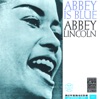
 Abbey Lincoln
Abbey Is Blue
Ojc
|
|
In one of singer Lincoln’s finest efforts, her sidemen reverentially occupy the fringes as the uninhibited vocalist lets loose, giving the song a boost of genuine spirituality.
|
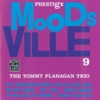
 Tommy Flanagan Trio
The Tommy Flanagan Trio
1992 Original Jazz Classics 183
Original recording 1960
|
|
Pianist Flanagan tackles this one alone, delivering a warm, soulful, and thoroughly beautiful interpretation of the Ellington number.
|
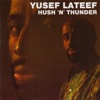
 Yusef Lateef
Hush ‘n' Thunder
2002 Collectable 6353
Original recording 1973
|
|
The combination of Lateef’s flute and the cello of Kermit Moore gives the song more of a chamber music reading than that of a jazz ensemble. Atmospheric and mesmerizing.
|
 Stanley Cowell
Back to Beautiful
1989 Concord Records 4398
|
|
Pianist Cowell sets a spring-like mood in his solo introduction before Steve Coleman enters on soprano sax. Bassist Santi Debriano and drummer Joe Chambers join in to pick up the pace for a joyous and imaginative reading of the song.
|
|
|
|