|
|
|
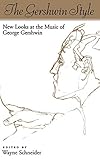
| “The appeal to jazz musicians is not the lyrics … so much as the repeated-note melody of the bridge combined with the riff-like melody in the A section.” |
|
 |
|
- C. Andre Barbera
|
|
| |
The musical comedy Funny Face opened to rave reviews on November 22, 1927. That night Adele Astaire and Allen Kearns would introduce “’S Wonderful!” a song that would immediately bewitch the Alvin Theater audience.
|
| |
| |
|
| |
|
|
| |
| |
|
| |
|
Funny Face starred comedian Victor Moore and the brother and sister team of Fred and Adele Astaire. Originally titled Smarty, the musical was overhauled after a disappointing opening at Philadelphia’s Shubert Theatre. The new title was Fred Astaire’s affectionate nickname for his sister.
With music and lyrics by George and Ira Gershwin and a book written by Fred Thompson and Paul Gerard Smith, the revamped musical would go on to enjoy a successful run of 244 performances. Included in the original score along with “S’Wonderful!” were hits such as “Funny Face,” “Let’s Kiss and Make Up,” “He Loves and She Loves,” and “My One and Only (What Am I Gonna Do?)”
|
| |
| |
|
| |
|
|
| |
| |
|
| |
|
Immensely popular from the outset, “’S Wonderful!” hit the pop charts twice in 1928. Its first appearance of the year was courtesy of Frank Crumit who took it to fifth place that January. The song struck success again in March when an Ipana Troubadors recording reached twelfth place.
|
|
| |
|
| |
|
The Astaire siblings, on the other hand, were not to share in the same good fortune enjoyed by “S’Wonderful.” While vacationing in the summer of 1928 Fred was a passenger in a serious automobile accident, and Adele was badly burned in a boating accident, requiring weeks to recuperate in hospital. Despite the setbacks they were both in London that fall for another 263 performances of Funny Face.
The 1957 Paramount film Funny Face is generally well-reviewed and was based on an unproduced play named Wedding Day and also starred Fred Astaire, this time with Audrey Hepburn. The songs were mostly Gershwin, four of which were in the original show.
|
|
|
|
More information on this tune... |
|
- Jeremy Wilson
|
|
| This section suggests definitive or otherwise significant recordings that will help jazz students get acquainted with
“'S Wonderful!.” These recordings have been selected from the Jazz History and
CD Recommendations sections.
|
Fred Astaire was the vocalist most closely associated with “’S Wonderful,” ( Fred Astaire's Finest Hour) and his 1952 recording with Oscar Peterson gives us the dual pleasure of a charming, faithful rendition of the tune, while putting it in the context of an exceptional jazz performance. As for instrumental versions, the Stan Getz recording of 1950 (B000005HAL ) with the young Horace Silver on piano is an all-time classic .
Noah Baerman - Jazz Pianist and Educator
|
Arguably, the lyrics are what make “S’Wonderful!”
so wonderful. The slurred transformation of words
such as “It’s Wonderful”(“S’Wonderful”) and “It’s
Marvelous” (“S’Marvelous”), coupled with clipped
syllables from words in the verse (“fashion” becomes
“fash”, “emotion” becomes “emoshe”), creates a whimsical
wordplay within a sophisticated song. In such context
the lyrical device is clever, not just cute, making
it memorable to the listener.
Interestingly, the song appeals to jazz musicians
despite its lack of musical complexity. As with
many standards, it is the listener’s knowledge of
the lyrics that makes “S’Wonderful!” a recognizable
and enjoyable target for jazz arrangements. The
simplicity of the song offers musicians a good vehicle
to showcase their improvisational skills. In Wayne
Schneider’s
The Gershwin Style: New Looks at the Music of George
Gershwin, contributor C. Andre Barbera says,
“S Wonderful!” is George Gershwin’s
most skeletal song. The appeal to jazz musicians
is not the lyrics … so much as the repeated-note
melody of the bridge combined with the riff-like
melody in the A section.
The appeal of this simplicity is twofold: it
allows the musician more freedom to improvise, and
it takes the emphasis off the melody, accentuating
the rhythmic and harmonic progressions. -JW
|
Musical analysis of
“’S Wonderful!”
|
| Original
Key |
Eb major
with false key change to G major in the
bridge |
| Form |
A1 – A2 –
B – A3 |
| Tonality |
Major throughout;
almost completely pentatonic; range of only
an octave |
| Movement |
“A” is based
on a downward minor third repeated twice,
followed by a downward interval or step
up. “B” is all step-wise over a three-note
range. |
|
Comments
(assumed
background)
|
|
There is some speculation that this very
simple melody was inspired, influenced by,
or based on canonical chants that Gershwin
heard as a boy in the synagogue or possibly
in a Yiddish theatre production. Certainly
the downward minor third could be the “mother
of all intervals,” existing in virtually
all folk music traditions, work chants,
field hollers and sacred chants. It’s even
one that children seem to know innately
(“nah-nah-nah”). In addition, the pentatonic
scale is the most ancient of all recorded
musical scales. Underneath its “skeletal”
simplicity, there is something almost mystical
about this tune. Wedded to the sophisticated
harmonic progression (I – bii˚7 – ii7 –
V7 – I) and Ira’s petulant and witty lyric
(itself based on Yiddish dialect), this
is a powerful piece of music. |
|
K. J. McElrath - Musicologist for JazzStandards.com |
|
George Gershwin’s catchy tune was around for
eleven years before
Benny Goodman recorded it with his quartet in
1938. The next year, vocalist Lee Wiley, along with
some of Eddie Condon’s gang, did a slow version
for a Gershwin tribute album.
In one of the many sessions of standards that
Coleman Hawkins recorded in 1944, his version of
“’S Wonderful” is performed by a swinging group
including hot trumpeter and frequent colleague Roy
Eldridge and pianist
Teddy Wilson (also on Goodman’s version). (There
are two takes from this session on different CDs
listed below.) The following year Artie Shaw’s big
band recorded an excellent arrangement of the tune,
featuring the leader on clarinet. It wasn’t until
1950 with Stan Getz’s rendition that this tune began
to be recorded again with frequency.
Chris Tyle - Jazz Musician and Historian
|
Additional information for "'S Wonderful!" may be found in:
|
|
|
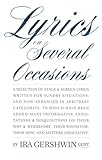 Ira Gershwin
Lyrics on Several Occasions
Limelight Editions
Paperback: 424 pages
(3 pages including the following types of information: history and song lyrics.)
|
|
|
|
|
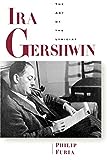 Philip Furia
Ira Gershwin: The Art of the Lyricist
Oxford University Press; Reprint edition
Paperback: 308 pages
(3 paragraphs including the following types of information: lyric analysis.)
|
|
|
|
|
 Gerald Mast
Can't Help Singin'
Overlook Press; Rei edition
Paperback: 400 pages
(2 paragraphs including the following types of information: lyric analysis and music analysis.)
|
|
|
|
|
“'S Wonderful!” was included in these films:
- Rhapsody in Blue (1945, )
- An American in Paris (1951,
Gene Kelly)
- Funny Face (1957,
Fred Astaire and Audrey Hepburn)
And on Broadway:
- My One and Only (1983, at
the St. James Theater, 767 performances)
|
| This section shows the jazz standards written by the same writing team. |
|
|
|
|
Comment Policy
- Your comments are welcome, including why you like
this tune, any musical challenges it presents, or additional background information.
- Jazz musicians, fans, and students of all ages use this website as an educational resource.
As such, off-topic, off-color, unduly negative, and patently promotional comments will be removed.
- Once submitted, all comments become property of JazzStandards.com.
By posting, you give JazzStandards.com permission to republish or otherwise distribute your comments in any format or other medium.
JazzStandards.com reserves the right to edit or remove any comments at its sole discretion.
|
|
| Click on any CD for more details at Amazon.com |
 Stan Getz
The Complete Roost Recordings
Blue Note Records 59622
Original recording 1950
|
|
The immensely influential saxophonist Getz is heard here at the beginning of his prolific career as a bandleader. His own playing is fabulous, as is that of the pianist he had recently discovered, Horace Silver.
|
 Fred Astaire
Fred Astaire's Finest Hour
2003 Verve 52402
Original recording 1952
|
|
In a jazz setting, Astaire revisits this song with which he is so closely associated. Accompanying him on this classic performance are Oscar Peterson’s group, augmented by Charlie Shavers on trumpet and Flip Phillips on tenor saxophone.
|
|
 Helen Merrill/Clifford Brown
Helen Merrill with Clifford Brown
Polygram Records 14643
Original recording 1954
|
|
Vocalist Merrill was in top form when she collaborated with trumpet genius Clifford Brown and arranger Quincy Jones. This swinging, up-tempo romp on “’S Wonderful” is a highlight of that collaboration.
|
 Art Tatum
The Tatum Group Masterpieces, Vol. 1
Pablo
Original recording 1954
|
|
Pianist Tatum is on fire here, as are his cohorts, alto saxophonist Benny Carter and drummer Louis Bellson.
|
 Sonny Stitt
Kaleidoscope
Original Jazz Classics 060-2
Original recording 1952
|
|
Saxophone master Stitt delivers a straight-ahead, solid offering, full of robust phrasing and playful asides. Though the sound quality is not pristine the bebop shines through.
|
 George Van Eps
Mellow Guitar
1999, Euphoria Records
Original recording, 1956
|
|
When Van Eps' debut album was released it was a sensation among jazz fans at a time when great jazz filled the airwaves. The master seven-string guitarist is not only an extraordinary technician but a creative genius, and the orchestral backing, used subtly and occasionally, is masterful. Great selections throughout.
|
 Eddie Harris
The In Sound/Mean Greens
1993 Atlantic 71515
Original recording 1965
|
|
The brilliant, underrated saxophonist Harris plays “’S Wonderful” with a propulsive Latin feeling, interacting with the buoyant rhythm section of pianist Cedar Walton, bassist Ron Carter and drummer Billy Higgins.
|
 Diana Krall
The Look of Love
2001 Verve 314549846
Original recording 2001
|
|
The Canadian pianist and torch singer gives the song her trademark smolder. Her husky voice and eloquent playing draw listeners in and hold them entranced.
|
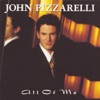
 John Pizzarelli
All of Me
1992, Novus 63129
|
|
This album hails from the early days of the prolific guitarist and singer. Pizzarelli’s version of “S’Wonderful” swings with the best of them.
|
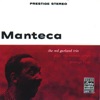
 Red Garland
Manteca
1991, Original Jazz Classics 428
Original recording, 1958
|
|
Pianist Garland, bass player Paul Chambers, and drummer Arthur Taylor are joined by conga player Ray Barretto in a version that stands out for its exceptional solos.
|
|
|
|